Showing posts with label #Communication. Show all posts

Monday, 14 September 2015

The Art of Communication - Do we say more than we think

Building bridges for the future, it’s harder than it looks!


How many of us automatically look to HR or the Sales guy as an example of a great communicator in our company? How many of us use the same comparison to excuse bad communication from others and ourselves? Afterall, if he’s not a Sales guy, he doesn’t need to be a great communicator, right? Good communication is a requirement for everybody at all levels; if a company is going to be successful over the longer term! It’s the glue that binds people, processes and technology together under a single roof.


So what makes a good communicator? Naturally social sales type? Sure… but the fact is that we can all make good communicators no matter how introverted or extroverted we are! All we have to do is package our message, deliver it so our intended recipient can receive it, decode it and most importantly understand it in the manner that it was intended to be understood in!

Seems straightforward but good communication is dangerously deceptive to grasp in companies of all sizes. Bad communication has quite rightly gotten or shared the blame for many things including:
  • Strategic errors due to misunderstandings between managers and C-suite executives.
  • Poor morale due to poor employee-leader and employee-employee communication.
  • Employees leaving managers/leaders due to endemically bad communication on the part of the manager/leader.
  • Employee disengagement due to bad corporate communications policy and resulting company culture
  • Creation of a fear based working environment
  • Workplace harassment, bullying and intimidation. 
So what is the ‘secret sauce’ that creates good and/or great communication in groups and companies alike? I submit that the following should act as key ingredients  to good/great communication:

Listen more than you speak - the art of communication is understanding. To understand your counterparty, you need to listen to them, understand their message in verbals (e.g. what they are saying/how it is said) and non verbals (e.g. body language/context).

Be emotionally discerning - context is important, if you understand your counterparty’s message, be sure to understand their emotional message also. An angry rant about a supplier may on any other day may be an irritated tangent.

Never make a permanent decision based on a temporary emotion - in times of conflict or apparent conflict, counterparties become adversarial and posture aggressively, which is quite literally “fighting talk!” We naturally respond to aggression with aggression, which even at a subliminal level can lead to ‘heat of the moment’ decisions that can irreparably damage reputations and relationships. In such a situation, a good communicator no matter how challenged they are will respond to aggression with assertion valuing protection of interests over protection of position in a conflict situation.

Understand your environment and company culture - too often, a manager with a background in a hierarchical or dictatorial company culture will be placed in a company that has a adhocracy or clan culture meaning a directional manager brings situationally unaware (aka. directional) communication skills with him into an environment that requires consultative leadership. The results unchecked become disastrous over time.


 Know your stuff - knowing what one is talking about is key to good communication. It’s critically important that integrity fills the gap when one does not know or understand something. It’s ok to confirm what was said, ask for a fuller explanation and admit one does not know something. Make it an opportunity to collaborate in search of the missing information. Setting arrogance and ego aside in cases like this defines a professional communicator and wins over an audience. Respect is earned by being professional and following the facts to a logical outcome.

Watch your body language - I have come across many situations where someone would be talking to me in a focused manner but have very aggressive body language. Their words would say “Hey John, when are we expected to deliver on this initiative” and their body language says “Hey stupid, you gonna deliver and make me look good or shall I find someone else to do it after I fire your ass!” Mean what you say and say what you mean. Counterparties will sense deception and even if it’s not meant, your reputation will take a nosedive along with your credibility if you get a name as a schemer/deceiver!

Focus on interests - Leave the posturing and aggression to professional politicians and amateurs. Professional communicators will always set aside positions for interests and treat their counterparty with respect even when they don’t deserve it. In focusing on interests, you set yourself above the rest by simply finding common ground to communicate with your colleagues/counterparties and gain respect by simply giving it, yet maintaining a stance over your own interests and asserting them when needed.

 Now for the art… the self control, thoughtful orientation and situational awareness of the professional communicator will always have an artful agility to their communication style that connects beyond the professional to one’s personal/core values. Those with the artful x factor are charismatic and have the ability to understand their counterparty accurately through what they say, what they don’t say and how they carry themselves. The artful communicator sees a complete picture of who they are and instantly tailors their communication approach to effectively communicate with the individual on an individual basis. Culture, status, power, life stage and social orientation all matter. It’s the artful communicator that can see this in an instant and communicate in a manner leaving the person with a warm feeling that they know them better than they know themselves!


Who you are reflects in what you say, how you say it and what impression you leave with people you communicate with. Make it good by staying true to yourself, your sense of self and how you want to be remembered in this world. For each of us, it is different, but to effectively communicate, don’t be afraid to bring others into your world if even for a moment. Life will be fuller and happier for the effort…


Sources/Credits:

Pics;


Credits;

Petr Kratochvil took the feature photo (family communication) posted on www.publicdomainpictures.net


Monday, 15 September 2014

Organisational communication. The power of progress!

Are sustainable practices practical?...


Since the days of hunter gatherer man, advanced group communication has being an evolutionary advantage man has used very well to this very day managing to forge ever larger and more complex groups in the achievement of group goals and objectives.

However, as we know, people fail, groups fail, companies fail and what is never missing in the aftermath is recrimination about how communication was used, misused and/or abused in the run up to the identified failure.

There is no doubt in my mind that good organisational communication is an integral part of all success but how do we define good communication and is it sustainable?

Organisational communication can be broken out in to the following types:

Downward and Upward Communication – from or to your reporting superiors, it’s a one-way/two way communication channel that acts as a message channel with little room for two-way dialogue in some cases.

Lateral Communication – Peer to peer communication between colleagues of the same level. Tends to be more informal with limited but speedy decision-making and peer collaboration noted as prominent characteristics.

Diagonal Communication – This is multi level, cross-functional communication that is more interactive and collaborative with multi functional interactions to a specific goal or objective.


Models of communication define the inset structures to which we communicate in organisational groups and are equally as fascinating in so far as they are reflective of how group processes actually work. Some of the more common ones are as follows:

Wheel Communication – This is a structured model based around a single point in the organisation (e.g. the customer) with all other people, functions and groups connected directly with this single point but structured in silos where they are limited interaction with each other due to being a “fixed point on the wheel”.  It’s normally used in customer centric models where vertical organisational models are present.

Helical Model – This is a form of communication for more lateral or matrix organisations where flexibility and organisational focus on task (V functions/silos) is required. As the project or task progresses, the circle of communication widens eventually producing an outcome.

Poole’s Model – This is a multi track communication with two main elements, the task track and the relation track. The former focuses on the task at hand and formal collaboration in group settings in order to identify a solution to the issue. The latter is an informal group setting where social bonding aids group cohesion and progression of the task/issue. Switching between the two is known as break points.

Chain Model – This is a singular dictatorial method of communication where instructions are given in a downward communication flow with no room for two-way communication.

Stephen Covey once said “most people do not listen with the intent to understand, they listen with the intent to reply” which is especially true when we look at people in organisational communication and it’s potential for a win-lose result.          


When thinking of organisational communication, we need to think of what we want to achieve with our business and how we will do it? If we do, then the question of sustainability is answered. So if long-term sustainability in communication is required, how do we structure it in an effective way? In broad terms, we should consider a sustainable communication model in context to the following:

  • ·      Product range; present and future
  • ·      Industry presence & culture; present and future
  • ·      Company culture and established business practices
  • ·      Strategic planning and change management burdens to the medium term
  • ·      Regulatory and Legal requirements

We need to ensure we get a “good fit” for our organisational communication model in the present and have enough time to enact complex multi functional change into the future should our communication model require it.

Exploring this point, imagine an unforeseen need for multi layered, cross functional collaboration requirement on project(s) critical to a company’s survival, which has an autocratic organisational model and a hierarchical company culture with chain communication driving all downward layers of the organisation to blindly carry out instructions. As the project progresses, a sudden need for constructive dissent and independent thinking appears, but is missing in this case increasing the changes of impacting failure.

If we understand our company vision, its direction, its culture, its markets and ourselves, we can define, incorporate and develop a modus of communication that seamlessly fits into our organisational structure which hums positively in daily business flexing and changing with the winds of time. If we achieve this, then I submit we achieve sustainability in our communication model, which will act as binding glue holding the “company ship” together and keeping it afloat in all weathers.


Sources/Credits:

Pics:


Credits:


Tuesday, 29 July 2014

Interest Based Negotiation, answering conflict with success!

Finding the “win-win” in us all!!


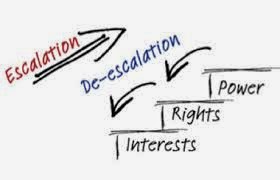
There is no doubt that the vast majority of conflict, whether it is in the office or on the battlefield is fuelled by misunderstanding and miscommunication between two or more parties. Of course, one can assume that conflicting positions produce conflict but I argue that the risk of escalation can be decreased and the probability of resolution increased if all parties actively look to reconcile their interests from the beginning through interest based negotiation.

Williams & Schneider in 1983 conducted a study on counter party negotiation techniques and found 4 different clusters of negotiator existed. The negotiator clusters were classed as ethical and unethical “adversarial” along with true and cautious “problem solving”. The results were startling! The counterparty in the study when asked to evaluate the style of the negotiator found the most effective negotiator to be “true problem solving” (72%) which is taking a genuine interest in the position and interests of the counter party and making a real effort to accommodate the interests of the counter party whilst protecting their own. At the bottom of the rankings was “unethical adversarial” (3%) which was defined by an aggressive posture and unwillingness to budge from their “position”.

So what can collaboratively engaging a counter party in a negotiation do for you? Seeking to understand your counterparty position, their interests that lie behind it and how their interests are impacted by your interests sets a negotiation on a more likely trajectory to success.

A well executed interest based negotiation technique can also:

Focus on best interests creating objective focus on best outcome, and not subjective bias driven positioning which often leads to failure
Addresses unethical behaviour designed to achieve leverage such as undercutting, non related blaming, discrediting, etc.
Un-fixes confrontational positioning by aggressive negotiators, thus becomes directional to collaborative outcomes.
Create a dynamic approach thus increases communication effectiveness and success probability through gaining best outcome for the collaborative negotiator who is assertive in IBN.


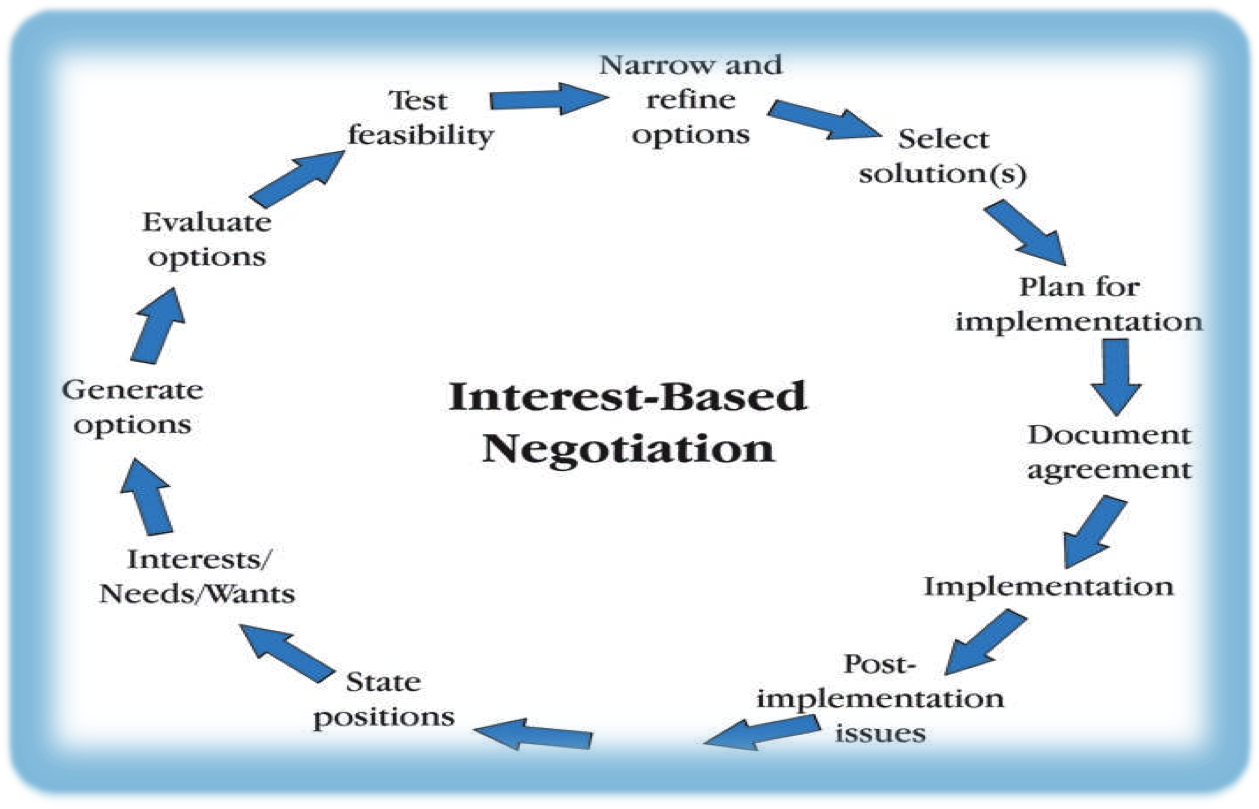
To get the most out ‘IBN’, I would submit the following be used as a process in any counter party negotiation:
  • Focus your Mind-set to be assertive yet collaborative. Clear your thoughts of unrelated issues and feelings, especially negative ones.
  • Address all party aggression with assertion by opening with a position of confidence leading to your statement of interests, not your statement of position which should remain open and unfixed until you have a clear understanding of your counterparty’s interests.
  • Identify your counter party misdirects by understanding their interest centre
  • Openly reconcile your interests to your conterparty interests for feasibility, which leads to credible counterparty acceptance and debunks hostile positions in-conflict with it
  • Be prepared to adjust your own “interest centre” if your own real interests are better served by such an adjustment.
  • If other party aggression supersedes acceptable levels, remember to never waiver tone of voice, increase volume to reassert one-self into the negotiation. Only do so if you can redirect to best interests and not inset positioning. If best interests cannot be refocused on, adjorn the negotiation rather then escalate into aggression.
  • When best interests are found which have being prioritized through the rationalization and comparison of all interests at the table, then a resolution can be agreed upon and documented including agreed follow ups.
  • Follow up on post agreement implementation issues and resolve on the basis of best interests being served for all.


With the collaborative approach to conflict resolution at any level in any environment, one can see how even unethical adversarial positions can be moved through interest based negotiation producing a “win-win” outcome. Concluding, I would suggest that in today’s conflict ridden world, maybe its time to abandon “win-lose” outcomes in favour of interest based negotiation which can bring all a better tomorrow in a manner, which can heal the wounds of today.


Sources/Credits

Williams & Schneider Results: Forbes  & Harv. Negot. Rev. 143

Interest Based Negotiation Chart: US Institute for Environmental Conflict Resolution

Pics: