Showing posts with label #Google. Show all posts

Monday, 17 August 2015

Google – Godfathers of Big Data or Big Business

Have Google reorganised to be a financial conglomerate or are they still a big data pioneer looking to better the world at a profit?

I must confess (as a guy who gives my Macbook & iPhone pet names) to being fascinated with Google’s rise and dominance in the market place. Google is the wacky place where weird ideas come to life, transform into something great and change the world!.. well a little bit anyway!... So have the Godfathers of big data succumbed to the Corporate World and joined the ranks of low innovation cash cow companies that present a “safe bet” for investors?

It would appear the media fallout from the big announcement last week suggests that it has but one thing is still clear; Larry Page and Sergey Brin are still in charge. Their rising star Sundar Pichai is now CEO of Google inc and is getting the positive press he rightly deserves. Google clearly have some positive goals in the restructuring that are consistent with the Google way in my view. The reorganisation will see a holding company (Alphabet) oversee subsidiary groups like the profitable Google (Inc) and YouTube, which will all be segregated from its high risk ventures like Self Driving Cars and storing human DNA in the cloud. The segregation of Google’s core business and high risk businesses in spin off subsidiaries present a conglomerate type set up that is arguably similar to that of Warren Buffett's Berkley Hathaway group.

Whilst ‘Wall Street’ may be joyful at the greater transparency of seeing the profitable businesses not carry those high risk ventures that may change the world, the entrepreneur in me sees a greater benefit in the better use of valuable acquisitions (e.g. Twitter) that have a corporate identity, brand and culture, which should be developed, not dissolved into Google’s identity. The flexible nature of what is proposed by Alphabet/Google leaves me with the impression that not only are they looking to shore up their over reliance on advertising (90%+ of revenue), the acquisition ability of the company may diversify into new markets whilst protecting their core brand assets of Google, YouTube, etc. This will allow them to innovate as well as acquire in a safer manner.

Its also noted that Google management in particular has promotional limitations given the prior centralised structure where Page and Brin were the decision makers on everything and it ALL went through their office.. IF they are willing to delegate real power to these new companies that operate under their umbrella, they have a greater shot at retaining quality management they developed from junior roles into senior roles that subsidiaries will now have. It also frees them up for group strategy management which can become very cumbersome especially if you become diverted and start meddling in the operational affairs of subsidiaries. Page and Brin’s trust in their talent to manage their subsidiaries must be well founded and developed with real track records. A majority of senior management appointed from within increases company longevity once there is a giver culture environment present (team player, collaborative, value your peers in get stuff done, etc).


So, with innovation taking a different seat at the table, it is fair to say that even bullish analysts are buoyant at the changes due to the increased profitability view. I would be moderately impressed if they would see this move as part of a larger prize move on strategy by Google, which in my eyes has the following elements:
  • Insulated and “profitable” company brands like Google/YouTube within Google inc can continue the revenue generation wonders whilst having their brands insulated against possible brand failures in the newer and/or high risk ventures.
  • Google’s internal promotion culture can take a shot in the arm with the ability to promote executes into spin off companies doing more senior jobs they they would ever have gotten as the old Google. Talent retention at Google will increase.
  • An alarming amount of Technology acquisitions are considered failures due to not meeting set goals, unforeseen integration problems and/or failure to create value in post acquisition settings. Google has not got a good track record on acquisitions, so they are rightly wary of them. Afterall, when bought, acquired companies are “Google”, which is a risky premise for Google’s brand should it all go wrong. The new structure mitigates that risk by allowing them to be a stand alone subsidiary as they were pre acquisition. They can be developed with their own brand, culture and business practices or if adding value to Google’s brand, they be integrated into Google inc.
  • Google’s transparency and structure will give a better platform for M&A should they want to go down that road. That said, they are innovating internally just fine, which will also benefit from the new structure.


The internal restructure of Google has allot of important points that are being worked out all over the internet and beyond. The biggest thing Google need to remember is what made them great, what will continue to make them great and never loose sight of why they get up in the morning, which is to make the world a better place with their products, services and ideas. “Don’t be evil” for Googlers is about being ethical in achieving that positive impact on the world. If they stick to it, they may well rise under Page and Brin’s strategic guidance in this new structure as a revamped Google that will last far longer than anybody thought it would. What happens next?... thats anybody’s guess.. whats your opinion?


Sources/Credits

Pics;


Credits;


Monday, 20 April 2015

Google… Market Monopolist or Anti-Trust Victim…

Anti-Trust Accusations by Europe, it is telling… but what of??


We all know and love Google search! Its useful results made Google the No. 1 search engine based on a its simple premise of returning sites in searches that are most recent, most used and most relevant.

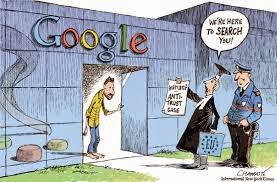
So what has landed Google in trouble in Europe? The EU regulator this week is charging Google with a breach of their Anti-Trust laws through unfair favouritism of it own e-Shopping services by returning them in Google search engine results before competition like eBay, Expedia, TripAdvisor and Amazon.  If successful, this apparently tactical charge (Shopping Services) may open up Google to further charges from the EU Regulator noting the Regulator has already opened an investigation into its Android platform following complaints about alleged abuse of market power in deal setting for the platform, which requires Google apps to be pre-installed and pre-set including Google search engine. 

The truth will have to be gleaned by the regulator and the EU commission, as it’s very unclear to me that their search engine business practices meets the criteria for ‘search engine bully’ as is implied by the allegations made in this case. Microsoft had an unapologetic policy of Windows only and was quite ruthless in its pursuit of control in the market place making the 2000 Anti-Trust case very visible and justifiable. Google on the other hand have a more-cloudy position where their priority search engine technology allegedly returns its own shopping services first. Does it? I tried to see if I was shunted into a ‘Google shopping cart’ in the search engine. The screen shot result below doesn’t quite tally with the allegations.


95% on average of all Google search engine users don’t go past the first page, so even if this is true, isn’t the user going to see the most popular visited sites as quickly as they will see Google shopping sites? In fact, when I Google’d “eShopping” today, I got American Airlines for some reason coming up trumps in this key search word. No sign of Google shopping services per the allegations. So the cloudiness continues…

Google has had prior issues in Germany in the past about redirects to articles in newspaper websites from Google search engine. They were being done without newspapers like Der Spiegel getting a per click payment for the view of the article referred from Google. What they failed to realise is that nearly 90% of the traffic on their site came from Google. When the regulator sided with the complainant, Google simply shut down in Germany and the business impact on lost digital revenue sent shock waves through the country that led to reversals of decisions through “exceptions”, which lifted rulings that financially impacted Google allowing traffic to reopen whilst saving face for European politicians and regulators alike. In my view, a lack of in-depth understanding on behalf of the Complainants, Politicians and Regulators alike led to a “storm in a teacup”


Bearing the above in mind, my advise to Europe’s current Anti-Trust Chief Margrethe Vestager is to not reach a final opinion on culpability until the following is fully understood:
  • ·      Complainant(s) complaint and true motivation for the complaint. Also, do they fully understand the implications of their complaint?
  • ·      Technical area affected by the complaint, is it fully covered and fully understood by the senior regulatory team?
  • ·      Business impact of the changes “needed” from Google?
  • ·      Business impact of the changes “needed” on the complainants including a suspension of service by Google? It could be surprising to see how Google actually supports the complainants bottom line so in actuality, the claim that Google is using monopoly power to suppress their business may turn out to be incorrect. Google’s presence may actually support their business and without the digital connectivity of services through Google, they may suffer a loss in business rather then a gain in business through Google’s absence or inhibited service to current offering.
  • ·      Business impact on wider community if Google’s service was forcibly altered? What is the impact of any outcomes including business impact of any forced changes and precedent setting for any future complaints succeeding against this Internet search giant?


To Google’s CEO Larry Page, I would advise the following in relation to this case:

  • ·      An objective internal investigation is always a must when confirming the actual state of play on an issue V what senior executives “think” is going on. It’s not a question of trust it’s a question of verification and integrity of position taken.
  • ·      Understand the issues along with the interests of the complainants and the regulator. Also, understand how both parties interact with your business in its entirety
  • ·      If there is foul play on Google’s part that leads to unsustainable practice even for short term gain, find it and end it noting the key instigators whom use a taker mentality in overreaching for personal gain, which is in contradiction to ethical practice and company culture that Google certainly appears to embrace! Include the regulator in your investigation and findings. Show you are serious about protecting the rights of others in your role as a dominant market player
  • ·      Approach the regulator with a collaborative rather then confrontational mentality. Your chances of a “win-win” success even in the face of provocation are higher when you use interest based negotiation techniques within a collaborative approach. 


There is no doubt in my mind that the EU has a responsibility to protect its citizens from unscrupulous corporate entities that seek to profit of Europe to the detriment of its inhabitants. This applies to smaller players looking to use regulators to knock the competition as much as it applies to dominant players who abuse their position to profit at the detriment of community they claim to serve. Does Google fit this profile of a “market abuser”? I think the truth rests with the regulator and the completeness of their investigation. My own view based on watching Google culture for some time and noting the talent it retains is not consistent with Google being a “market abuser”. However, keeping an open mind, I shall be keenly following the case.  Am I wrong in my current opinion? Will I have to change it as more facts come to light? Let me know your thoughts...


Sources/Credits:

Pics;


Credits;


“Chanate” for International New York Times in the cartoon sketch of EU Anti trust warrant served on a Google building.

Monday, 6 April 2015

Cloud Platforms - What will yours be?

Reading between the lines in choosing between 3rd Party Hosting, PaaS and IaaS…


I am just finished by University Exams in Software and Cloud Technology ergo my return to blogging after a short break for the exams. In this intermittent period, my reflection led me to what I’ve learned about cloud technology and what impact it likely has on my plans for the future. On that note, I definitely see a role for cloud technology but even after studying cloud technology in detail, the vastness of cloud is truly mind-blowing in terms of its potential. Even loose comparisons are a daring venture when evaluating platforms, which gets even more daring when comparing providers.


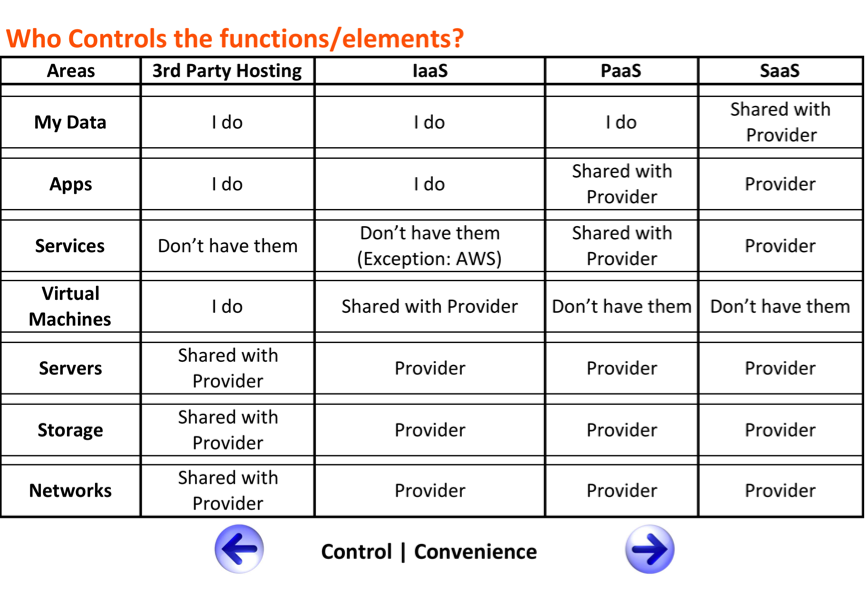
So if I were asked to describe cloud platforms I would give you the following synopsis as a rough high-level guide to what the platforms are from a control perspective:


It’s not easy thinking of what we want on complicated topics but if we think of the different platforms in terms of single statements, we could describe them as follows:

3rd Party Hosting = I want to host all my applications, services and data on somebody else’s servers and network sharing my own security and application maintenance/storage/etc. E.g. Blacknight (https://www.blacknight.com).

IaaS (Infrastructure as a Service) = I want to be free to host my own applications; services and data on someone else’s network, storage and servers, have good scalability and access to useful infrastructure tools and services; which allows me to package and deploy anything I want, without worrying about infrastructure maintenance from a V/M, server, storage and network perspective. E.g. Amazon Web Services (aka AWS http://aws.amazon.com).

PaaS (Platform as a Service) = I want to develop applications using someone else’s services, servers and storage not having to worry about maintenance so I can focus on development. E.g. Google App Engine (https://cloud.google.com/appengine/).

SaaS (Software as a Service) = I have a need for an application that I don’t want to buy as a client. I want to use it only when I need it and not worry about maintenance of the backend. I am comfortable sharing my data with the provider through the front end. E.g. Facebook (https://www.facebook.com).

So knowing what they are, its easy to see that the suitability for business needs can be diced and sliced for any business solution of any size, but in general terms the following can be held up as a general rule of thumb when looking to source a “cloud solution” for your needs:

a) 3rd Party Solution = Tech Savvy SME solution, an entrepreneur’s best friend!
b) IaaS=A tech savvy fast growing enterprise of any size seeing infrastructure as a bedrock for building and deploying scalable solutions from scratch upon.
c) PaaS=Development orientated for developers, enterprises that have a digital presence of any size and want to focus purely on scalable development rather then diversions into Ops or infrastructure maintenance.  
d) SaaS = Any business of any size who want to use services free or at lost cost that support its business development.  Its application based where the trade off is information inputted into the web application is shared with the provider.

When we think of cloud today, we have three titans that dominate the industry between them. AWS is by far the largest, with Google App Engine and Microsoft Azure coming up as leaders in the chase group to AWS.

One of the interesting points of note when one becomes established in the cloud is the increasing worth of the open source software movement’s offering through “Open Stack” (https://www.openstack.org/software/). It’s technically challenging to begin with but when mastered, it offers quick switches to other providers when outages happen or one wants to switch for other reasons (price rises, etc). It’s worth noting that big names like Google App Engine, Microsoft Azure and even AWS have outages that brings down your service, so when you are doing a risk review of your business network architecture creating a line on your risk register for cloud provider dependency, you now have some good options for risk mitigation through Open Stack.


Did you ever get a headache comparing platform providers? I know I did! Choosing four providers, Blacknight, AWS, Azure and App Engine compiled with some metrics gives you the following flavour of what to expect to get started in your cloud provider search:

Table 2 Metrics - Development & Pricing


Table 2 Metrics - Storage & Services

*Note: Every attempt has being made to make these comparison tables accurate as of May 2015 noting it is not exhaustive. There are comparable providers of cloud services that are not included in this list.

As you can see, even a focused attempted to get comparable prices, services and attributes of cloud services is very difficult to capture in a blog article such as this, but hopefully you will have a starting point on choosing a cloud platform.

It comes at approximately 10% of the price of in-house solutions, has “big company” applications, services and attributes that allow the smallest of start-ups to compete on level digital playing field. Pricing is inherently linked to volume and usage, which makes revenue-generating activity on your network a profitable venture given the lower and more reliable overheads incurred with Cloud.

On the downside, there are outages outside of your control, but they are rare and often very short.
There are also security issues for companies dealing with more sensitive data from propriety data upwards, which present day cloud solutions may not be suitable for. Also, you can become a victim of your own success if your website, applications and platform traffic increases but your revenue generating activity does not keep pace. Your income over expenditure gap can quickly reduce leaving you with a big bill and not the means to service it.


Cloud technology can play a part in your digital solution and as the technology continues to improve, innovate and augment, more and more opportunities for cloud will appear with the value proposition clearly in your hands. Why not start today and see what cloud tech can do for you? I know I did and I have no regrets!


Sources/Credits:

Pics;


Credits: