Showing posts with label #PaaS. Show all posts

Monday, 27 April 2015

Cloud Technology… is it really here? Well is it?

Solutions are becoming more streamlined, but where is it all going?



Last Saturday saw me at a Microsoft Azure “boot camp” where I chatted with some very talented industry professionals and listened to their opinions on the “new” Microsoft Azure! It was worth my while rising early on Saturday to go there and hear some of Microsoft’s senior Engineering talent talk about the new Azure and how it will make development life easy from Websites to MVC web Apps to Cloud Services. Impressed by their presentations, it got me thinking about where Cloud is going and how Microsoft’s latest offering in high level terms is similar enough to that of AWS in particular given its notable improvements in virtualisation functionality and an impressive ease of development which AWS should take note of in my view.


Whilst Microsoft, AWS and all cloud computing competitors have put allot of thought into their offerings, differentiation can be difficult thus deciding what is good for you and/or your business can be a hard task for even the informed developer and/or business owner.  There is no doubt that the major players have a good support structure in place to help businesses decide but ultimately, it comes down to the cost benefit of the value proposition when placed against a company’s need for consistency, availability and partitioning of transactions in their data management plans. Knowing what you want in detail before looking for value in a Cloud partner is key to getting what you need to be successful in your use of cloud computing! In short, know your data management requirements inside out and then go look for a cloud provider!

My mind then moved onwards thinking about the future and how these marked improvements will feature in marketplace and competitor reaction as the competition cycle keeps on turning. A couple of things came to mind, which I would like to share with you as possible “watch that space” points for the short to medium term future:

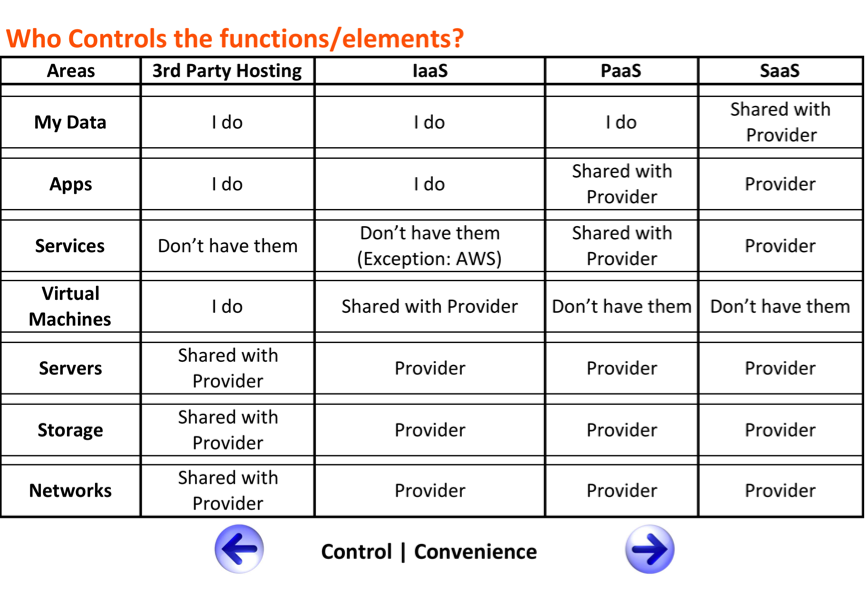
Data convenience: As in life, there is a continuing shift in business towards convenience.  A hallmark of cloud systems in PaaS and SaaS in particular is that it’s controlled more by the provider then you as the customer. As convenience is the keyword, you don’t have to do your own updates, manage your security, etc. IaaS is a little different in that your use of virtual machines requires more maintenance from your IT guys but offers great flexibility at the cost of a little convenience. The details make it a powerful product type, in which AWS and Microsoft are key players.

Trust: Given the high performance rates and availability track records of the major providers to-date, trust is building in cloud computing that is leading to more and more “trusted” use by consumers and business alike. These increasing usage levels has higher business and operational risk weightings, which has being retained or off the table for any cloud solution in the past. Trust earned is making convenience a unique selling point for cloud solutions!

Databases: The industry’s wary welcome of NoSQL in particular is starting to mature into an embrace that sees database and network storage solutions develop at a faster and faster pace. The big sell for SQL and relationship databases (RDBMS) has always being its “relational” features in SQL that allows analysis and joins with data in schema tables to happen gleaning insights for the business who uses RDBMS’s wisely. This has being the way for many decades since Oracle V2 with NoSQL now getting the positive attention it deserves. Its development into cloud has given it a good grounding for large network benefits that are getting better and better by the day, from large parallel computing jobs where huge amounts of data are processed in a short period of time to the narrowing of the bridge between SQL (i.e. Relational) and NoSQL (i.e. Non-Relational). The latter is the more recent development with great improvements reaching market like Drill and Data Lake, which are effectively narrowing the relational and non-relational divide making modelling, management and SQL “like” querying more integrated, useful and flexible to user needs. This handing of power into the hands of the user is why I think database and storage solution technology will eventually migrate into a single interface and storage management system? Who gets there first with a fully functional “one stop shop” for your truly centralised storage solution needs from one user interface? Well that’s anybody’s guess!!

Security: Security is always an issue when you are ‘trusting’ your cloud provider to take care of your data. The ability to get hacked is always present but so is the growing and evolving expertise of the cloud providers who have shown a capability that is certainly making “hacking” a more difficult and faster changing occupation. It’s a never-ending battle between hacker and provider, which indicates to me that the ability to maintain data integrity from hacking will be a keynote element in the progression of cloud technology. Consider this, if a cloud technology titan like AWS could be hacked and brought to its knees, the consequences in business terms would be catastrophic for whole industries, never mind whole companies!


The responsibility that cloud providers take on in the war against hacking is a grave one and to date, their success lies in the preservation of their network’s integrity, which has opened an impacting gateway for society’s data management needs! Least they fail; we all fail… best they succeed and we all succeed in maintaining a key part of our infrastructure in society’s continuing journey!

So if increasing trust is matched with more developed risk management approaches in using a fast developing platform for our data needs, I submit that our flexibility as a society can rest upon such an axiom and enable great things in the years to come!

Do leave your opinion on cloud technology in the comments section… I would love to get your take on the newest arrival to our digital world!


Sources/Credits:

Pics;


Credits;


Microsoft for its presentation of Microsoft Azure during the “Azure Boot Camp!”

Monday, 6 April 2015

Cloud Platforms - What will yours be?

Reading between the lines in choosing between 3rd Party Hosting, PaaS and IaaS…


I am just finished by University Exams in Software and Cloud Technology ergo my return to blogging after a short break for the exams. In this intermittent period, my reflection led me to what I’ve learned about cloud technology and what impact it likely has on my plans for the future. On that note, I definitely see a role for cloud technology but even after studying cloud technology in detail, the vastness of cloud is truly mind-blowing in terms of its potential. Even loose comparisons are a daring venture when evaluating platforms, which gets even more daring when comparing providers.


So if I were asked to describe cloud platforms I would give you the following synopsis as a rough high-level guide to what the platforms are from a control perspective:


It’s not easy thinking of what we want on complicated topics but if we think of the different platforms in terms of single statements, we could describe them as follows:

3rd Party Hosting = I want to host all my applications, services and data on somebody else’s servers and network sharing my own security and application maintenance/storage/etc. E.g. Blacknight (https://www.blacknight.com).

IaaS (Infrastructure as a Service) = I want to be free to host my own applications; services and data on someone else’s network, storage and servers, have good scalability and access to useful infrastructure tools and services; which allows me to package and deploy anything I want, without worrying about infrastructure maintenance from a V/M, server, storage and network perspective. E.g. Amazon Web Services (aka AWS http://aws.amazon.com).

PaaS (Platform as a Service) = I want to develop applications using someone else’s services, servers and storage not having to worry about maintenance so I can focus on development. E.g. Google App Engine (https://cloud.google.com/appengine/).

SaaS (Software as a Service) = I have a need for an application that I don’t want to buy as a client. I want to use it only when I need it and not worry about maintenance of the backend. I am comfortable sharing my data with the provider through the front end. E.g. Facebook (https://www.facebook.com).

So knowing what they are, its easy to see that the suitability for business needs can be diced and sliced for any business solution of any size, but in general terms the following can be held up as a general rule of thumb when looking to source a “cloud solution” for your needs:

a) 3rd Party Solution = Tech Savvy SME solution, an entrepreneur’s best friend!
b) IaaS=A tech savvy fast growing enterprise of any size seeing infrastructure as a bedrock for building and deploying scalable solutions from scratch upon.
c) PaaS=Development orientated for developers, enterprises that have a digital presence of any size and want to focus purely on scalable development rather then diversions into Ops or infrastructure maintenance.  
d) SaaS = Any business of any size who want to use services free or at lost cost that support its business development.  Its application based where the trade off is information inputted into the web application is shared with the provider.

When we think of cloud today, we have three titans that dominate the industry between them. AWS is by far the largest, with Google App Engine and Microsoft Azure coming up as leaders in the chase group to AWS.

One of the interesting points of note when one becomes established in the cloud is the increasing worth of the open source software movement’s offering through “Open Stack” (https://www.openstack.org/software/). It’s technically challenging to begin with but when mastered, it offers quick switches to other providers when outages happen or one wants to switch for other reasons (price rises, etc). It’s worth noting that big names like Google App Engine, Microsoft Azure and even AWS have outages that brings down your service, so when you are doing a risk review of your business network architecture creating a line on your risk register for cloud provider dependency, you now have some good options for risk mitigation through Open Stack.


Did you ever get a headache comparing platform providers? I know I did! Choosing four providers, Blacknight, AWS, Azure and App Engine compiled with some metrics gives you the following flavour of what to expect to get started in your cloud provider search:

Table 2 Metrics - Development & Pricing


Table 2 Metrics - Storage & Services

*Note: Every attempt has being made to make these comparison tables accurate as of May 2015 noting it is not exhaustive. There are comparable providers of cloud services that are not included in this list.

As you can see, even a focused attempted to get comparable prices, services and attributes of cloud services is very difficult to capture in a blog article such as this, but hopefully you will have a starting point on choosing a cloud platform.

It comes at approximately 10% of the price of in-house solutions, has “big company” applications, services and attributes that allow the smallest of start-ups to compete on level digital playing field. Pricing is inherently linked to volume and usage, which makes revenue-generating activity on your network a profitable venture given the lower and more reliable overheads incurred with Cloud.

On the downside, there are outages outside of your control, but they are rare and often very short.
There are also security issues for companies dealing with more sensitive data from propriety data upwards, which present day cloud solutions may not be suitable for. Also, you can become a victim of your own success if your website, applications and platform traffic increases but your revenue generating activity does not keep pace. Your income over expenditure gap can quickly reduce leaving you with a big bill and not the means to service it.


Cloud technology can play a part in your digital solution and as the technology continues to improve, innovate and augment, more and more opportunities for cloud will appear with the value proposition clearly in your hands. Why not start today and see what cloud tech can do for you? I know I did and I have no regrets!


Sources/Credits:

Pics;


Credits: