Showing posts with label #Process Management. Show all posts

Tuesday, 5 August 2014

Effective Process Management: The 'Cult of Process' V The 'Cult of Personality'

Does effective process management impair dynamic management decision-making???   


We all have grown up with regaling stories of leaders whom have left footprints on society’s journey that are celebrated for their enormity as much as their achievements. Steve Jobs, Nelson Mandela, Jalal-Ad Din Muhammad Rumi, Mahatma Ghandi and President Abraham Lincoln are all such individuals whom have impressed us and fit the bill as great leaders!

Its easy to forget that even as we stand on the shoulders of giants, those pivotal moments in our history were always fraught with issues that surrounded great people whose charisma seemed to be the salvation to our problems when in fact, their brilliance lay in their message that inspired a process which delivered a successful outcome in that moment. So in business, why is there an apparent clash between process and personality when it comes to ‘great leaders’ making decisions?

I would say firstly that great leaders are defined in hindsight for their character as much as their achievements, which just leaves leaders, their decisions and the outcomes. So, “why does effective process management inhibit great decisions by leaders?”

The short answer is “it should not!”… However, it can and does due to many reasons, which can include:

Process design can be overly burdensome curtailing leader effectiveness by removing or drastically reducing decision-making ability. This can slow up organisational responsiveness to market changes and can become an inherent threat to the company’s long-term interests. Conversely, process design that does not control leader authority through setting justifiable boundaries can expose the company in many areas due to bad leader decisions that go unchecked to implementation. Balance in process design on leader authority is key.

Personality of powerful leaders can override process compromising its integrity. Accordingly, it looses effectiveness when others see how one leader can be the exception to process driven rule(s) they should all follow. This is cancerous in large organisations where unmanaged and unaccounted for exceptions can grind process structures to a disastrous halt creating a new suite of costly problems and risks for the company.

Divergent priorities of leaders to the company’s best interests set out in processes can be catalyst for conflict between process control ‘enforcers’ and leaders; inhibiting the leader’s ability to execute a decision he or she feels is a great one. A key to great process management is internal business acceptance of the structures. An impacted leader not included in any stage of a process design or upgrade will be more likely to resist process requirements.



So thinking about some of the common pitfalls in business, what helps in combining great leaders with great processes producing great moments in time?

Who takes the lead? The process manager should establish roles and responsibilities in the project initiation (stakeholder analysis) stages of any process revision clearly linking company objectives for the process and/or processes to function(s), to leader(s) and other stakeholders. This should form part of the stakeholder engagement process.

Reconciling Objectives. The project manager should solicit feedback on the process vision presented to the stakeholders noting any variances and the reasons for same. Identified issues should be recorded and managed to resolution via a working risk register.

Defined Goals, One vision. This should be the mantra of all process stakeholders. Anything else endangers process and organisational effectiveness especially if the customer has to work harder to effectively complete the process.

Create value, not paperwork. If a process step does not create value in its execution, then it should not be there. If a process can work effectively without it, then it should be removed.

Process Controls should be sewn into process design, not placed on top of them. A process control should never add work; it should add value by being a critical part of the process sequence creating value in process delivery whilst delivering feedback relevant on the risk identified in the process control.

Manage exceptions or they will manage you. A balance between leader decision-making scope and process control needs to be found in business practice, which critically influences company culture in many unseen ways over time. Managing process exceptions with a clear lean process flow helps by allowing the company to map out the impact of approved exceptions in terms of their risks, opportunities and outcomes.



So considering the above, the ability for leaders to be earthed in a good process matrix truly can be positive for all concerned. Like all the greats whom have gone before, a leader’s vision indelibly linked to inspired process structures translates vision into accomplishments which history can judge as being great.

Source/Credits:

Pics:


Wednesday, 9 July 2014

The back office, a single vision and the value proposition

Many value propositions synergised into one…


When thinking about the value proposition in business, we often confuse true value with just profitability, especially when thinking of the back office. This is fine if the business or proposition does not have sustainability in its design, which can be an appropriate omission in some industries, markets and territories. For the rest of us, sustainable business can be an attractive proposal, even radical when we think of how we could reposition our functions, structures and approach in the market place to make us more responsive, flexible and insightful in how we conduct business, why we conduct business and how we deliver our message of “who we are” to the customer in a seamless delivery with our goods and services. This concept transforms the value proposition of the back office formalising the interdependency between business development and structural consolidation of the business in growth, which has management, organisational and process management implications.

 So which saying is cooler...“Sell Sell Sell”, “Everybody is a Marketer” or “Cash Is King”??? For me, it’s “Cash is King” given my finance background, but in reality, all three are valid yet the customer is only interested in one answer to the question of “who we are”?  Are we the company that satisfies our customer’s needs on every level, in every area and on every approach? Do we deliver satisfaction and the same message managing expectations on a single strand that flows from initial approach to a 10-year account review?  Is our relationship with our customers evolutionary where we grow our business in partnership with our customers and our employees?

Once we fully determine who we are, we can then set about delivering our brand message to our customers that resonates as a “reason d’etre” for our employees, our customers and our management group. Synergy and integration lies at the centre of this wonderful picture, which brings us to how our overall performance as a company can translate into an effective sales message, which in turn lends credence to our sales approach revealing the value proposition in the eyes of the customer.

The key to this in integrated and synergistic approach is in my view lies within the process infrastructure of the business and how it binds the difference functions together in everything from planning to daily operations.

When we think of our function whether it be sales, production, finance, marketing, etc, it is easy to become lost in our functional interests making changing market demands difficult to respond to as a function and as company. Most can’t even entertain the concept of being flexible enough to reposition our organisations early to capitalise on identified market changes reaping the rewards of being one step closer to the customer and thus one step ahead of the competition.

 So, what to do??.... Chip sides of the customer and the organisation through Limit, Inhibit, Prevent, Control???? The response is indeed appropriate in some industries that has well defined inelastic products, are inflexibly vertical in their management structure and autocratic in nature. However, in companies that are in industries which have company cultures facilitating innovation and flexibility, the ability to “be as one” in a single message meeting customer needs is a thought intensive and demanding process. So where to be begin?

Start with the end in mind. Before the details can be worked out, the company needs to think of the desired value proposition, how much is left with suppliers, how much is retained in the company and how much is passed onto the customer through the provision of goods, services and ideas? Is the platform suitable in terms of process infrastructure such as lean six sigma, which delivers value and responsiveness in process infrastructure design, improving with time and changing market conditions?? Is the process platform ‘customer friendly’ delivering a balance of maximum returns with minimal effort on the customer’s part?

Understand your market(s), map your strategic plan and develop your process infrastructure to meet the requirements of your customers through hearing, seeing and feeling one penetrating ‘company message’ from all functions in the delivery of goods, services and ideas. When developing your strategic plans, its advisable to use big data analytics gleaned from your internal and external sources in identifying trends and insights relevant to your plans. Those who do so effectively are likely to gain competitive advantage. Once the process design creates and distributes value in service as much as in products to the customer where the single message is heard (we are…), then your outputs will feed positively into company practice, performance and culture setting the long term potential of the company’s value proposition into motion.

Be mindful of current process structures, organisational inhibitors, company culture and existing practices both good and bad.  The need to understand your current internal organisation is on par with the need to understand the external marketplace. Great process design will not be effective if context is not accounted for in any project execution. Project plans, which do not include scheduled step-by-step actionable tasks from the work breakdown structure, will not effectively forward the process infrastructure from its current state to its desired state. In some companies, effective process management can take years to get right, but as my dear old mother once said to me “the sooner you start, the sooner you will be finished!”  


Realism, not idealism is needed in planning change.  Be careful to appropriately plan your change initiative understanding its scope, impact and timing to deliver a comprehensive unified process infrastructure to the company as a platform with realistic cost estimations, risk management, timing calibrations and completeness in the project plan. Whilst important to not ‘pad’ your numbers and estimations, its also important to be able to stand over your stress tested plan, to sell it and not be pushed into compromising concessions by questioning and possibly unruly senior managers who should know better. After all, starting with the end in mind is enabling the business to reap a return for its investment through a value creating process platform that integrates the business as much as it does people and processes, by binding them together.

Being able to stand in front of a customer and say “we are…” is truly a wonderful feeling when we are part of something that is greater then the sum of our parts in a verifiable and unified way. The value proposition transcends monetization and creates intrinsic value in commitment, engagement, innovation and longevity in a company who would find itself bound and driven forward by its people as much as its management team and processes.

Source/Credits:

N/A


#Process Management, #Capitalism, #Business, #Projects, #Organisation, #Organization, #Management, #Development, #Sustainable, #Controls, #SSC, #Integration, #Restructure

Wednesday, 18 June 2014

Process Management, it’s time to be great!

Lean Six Sigma, when is it time for change?


Anybody who has worked in manufacturing or in the back-office will know some process; action or event could have being done better! Whether it’s small or large in our company, we rarely see timely change happen as a result of our idea creating value in higher productivity, lower costs or both! Sustainable Capitalism has evolved out of two main elements, the need for an ethical working conscience and the need for productivity driven value creation that aids innovation and growth in a socially aware manner. This in effect makes monetisation a consequential priority for if we develop products for market in a socially aware manner and deliver productivity solutions through top tier process management; our ability to make money is practically guaranteed.

So why does the idea of shortest path travelled to monetisation which can include process circumvention hold such allure for senior executives in planning sessions and indeed on a day to day basis? In my view, I think the following three elements are key in driving this short-term view especially in western business culture.   

  • 1.     The quarterly culture especially in “plc.” registered companies tends to put priority emphasis on shareholder value and cash positions in the deliverance of results. These priorities sit on the throne of perceived value alongside profitability even if it’s at the expense of one or all of them into the longer term.
  • 2.     The “treadmill effect” has being noted by some analysts as being a driver of irrational decision making in operational strategy where market demands fed by management’s exceeding of prior quarterly expectations demand the improbable which management set out to deliver at the expense of future longer term sustainability 
  • 3.     The “strategic planning cycle” in western business culture is rarely beyond 5 years and most senior executives are incentivised solely on their performance within this short to medium term period. The incentive to think beyond this for senior executives is for the most part not in place creating a short term planning culture, which only includes executive considerations that don’t exceed the cycle period.

There are more elements, but in my view, the above three are the most impacting and illustrate how understandable it is for many managers to not embrace sustainable capitalism’s need for longer-term productivity when priorities lie elsewhere. That said, there are competing schools of thought where value creation through efficiency and cost effective process management add value and years to a company’s lifecycle which has made companies like Toyota and IBM the evolving success stories they are today. The ideas are a fascinating evolution from the Kaizen continuous improvement methodologies originating in Japan approximately a hundred years to Toyota’s improved Kaizen system of materials handling to Six Sigma; then to Lean Six Sigma.

You would rightly say at this point “wow, great story but what has it got to do with my company and real life?”… Good question! Toyota, IBM and all the pioneers of six sigma have come up with the same statement as we invariably have in the course of our careers, which is “what can we achieve through making our processes better that would delight our customers, whilst increasing productivity and reducing costs?” The backdrop to this question has nearly always being high costs, low quality outputs and cumbersome processes driven by an organic evolution of process. The temporary nature of this shorter term focus has allowed in my view process inefficiencies to aggregate over time into company wide threats, which in turn has given rise to responses like Six Sigma and Lean Six Sigma with its company wide solutions.  

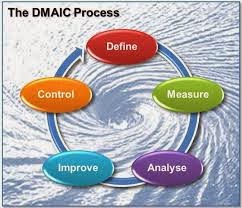
Lean Six Sigma has a structured and logical approach for both physical processes (Six Sigma) and services (Lean), which see an evolution of thinking in process improvement through some highly effective tools like the “DMAIC” process. 

·      Define the process as it is
·      Measure the process in quantitative terms using metrics to capture the value creation elements of the process
·      Analyse the causes of the problem inhibiting process productivity and/or high associated costs
·      Improve the process design to address the identified issues restricting value creation within the process
·      Control the process through revised metrics including lead and lag controls within the process structure which will measure the improved state of the process ergo ensuring value creation from process improvement.

Lean process management focuses on the amount of value creating steps it takes to complete a process, which has had a huge impact on customer facing services in particular where one process can replace many and a customer’s actions within the process are reduced to a bare minimum. Lean is based on the assumption that waste in business is toxic to its sustainability and thus should be eliminated based on the following process:
  1. Application*. Define the process focusing on where the value is for the customer.
  2. Identify Value Stream*. Define the steps within the process that add value and those which do not. Adding value can be direct or indirect in relation to the customer.
  3.  Make It Flow*. Ensure the process has a continuous movement with appropriate controls such as lead and lag to create and measure value creation in the process flow.
  4. Let Customer Pull*. Ensure you don’t over supply to your customer demand. Customer demand should be a trigger for production and service provision.
  5. Pursue Perfection*. Under the high bar of continuous improvement, there is no limit to process value creation and no ceiling of perfection.

With lean, the key is continuous flow of processes integrated in a demand driven process structure that allows the shortest effective process time line between process start and completion points increasing productivity and reducing costs as all non value creating steps are exited from the revised process.


With Lean Six Sigma, the combining of both methodologies in a company wide structure enhances the integration of effective internal process structures that increases productivity, decreases costs, increases output quality and resulting customer satisfaction. It also allows a company access to flexible control tools and information that empowers management and employees to pursue sustainable capitalism in a productive, cost effective and socially aware manner.

When we look at Lean Six Sigma, the concepts of high process quality leading to high outputs are braced in its scoring as follows:
  • ·      2 Sigma = 308,537 (69.15% productivity yield) faults per million
  • ·      3 Sigma = 66,807 (93.32% productivity yield) faults per million
  • ·      4 Sigma = 6,210 (99.38% productivity yield) faults per million           
  • ·      5 Sigma = 233 (99.98% productivity yield) faults per million
  • ·      6 Sigma = 3.4 (99.99% productivity yield) faults per million 

Its not hard to see the qualitative aspects of Six Sigma’s scoring system and how qualitative process design based on the value creation aspects of the process is so important for a companies success and sustainability over time.


As a practitioner of lean process management for over a decade, I feel that the birth of Lean Six Sigma is the next platform of process greatness bringing greater value to many facets of a company’s operation. That said, it is still a platform and from my own experience in process management, I would advise the following to anybody engineering, re-engineering or developing a process platform using Lean Six Sigma or any logical form of process management. 
  • ·      Contextualise your process design ideas into your operating environment, established business practices, the company culture, 3rd party business partner relationships and their internal culture(s) to understand what works, what doesn’t and how it all interacts with each other.
  • ·      Never forget your customer. The internal customers (other business units/colleagues) can become higher priorities when conducting an internal process review. It is therefore easy to forget the external customer who pays your invoices and funds your ability to conduct what very same review. Lean process management is about leaning into the customer and understanding how their needs and wants impact your process and vice versa.
  • ·      Process effectiveness requires understanding of what the desired outcome of the process actually is, where waste occurs and addressing the ineffective steps by withdrawing them in favour of what is effective to the desired outcome of the process. Above all, the process has to be contextually inset into the overall process structure and be flexible enough to handle the commercial needs of the organisation where outlier cases can be processed reasonably in a controlled manner through an established and integrated process structure.

We all strive to eliminate waste from our company and drive a better process environment. I submit that the time is now as we enter an upward economic trajectory to reposition our companies to a more sustainable footing using tools like Lean Six Sigma to evaluate ourselves internally, make the changes to business practice, attitude and approach, which in turn allows us to drive forward with confidence in our ourselves, our colleagues and our future. We can then see process greatness enable flexibility along with longevity in our partnerships with employees, business partners, customers and wider society for many years to come.


*Sourced from Trinity University, TX, USA.
-Sourced Six Sigma Pics: Six Sigma.au et Al.