Showing posts with label #resolution. Show all posts

Saturday, 31 January 2015

Sales & Finance, is friction-driving performance a good thing?

Cohesion V Conflict, the conundrum all companies must face!



We all know of the ‘Finance V Sales’ corporate battles as much as the ‘’Sales V Finance” iterations. The disagreements between Credit & Collections (aka Finance) and Sales are the stuff of office legends the world over. In some companies, declining a credit limit can invoke a response similar to that of a hostile takeover with alliances forged for the ‘big vote’ and relationships strained way beyond what a rational person would consider reasonable. That said, business seems to get done and the world continues to spin, so where is the sweet zone in the Sales/Finance dynamic and what can be done to make it more stable and productive??

Relationships are where it starts and ends, as the counterparties in sales and finance are people whom mainly interact through a direct relationship administrating the sales to cash process chain. Casting aside ones biases about the other’s function and building a relationship with the individual based on their individual merits rather then the reputation of their function is of paramount importance.  

Process Understanding is an overlooked concept for both parties whom are often influenced by a ‘silo’ mentality. This often leads to process knowledge being withheld due to a lack of trust, cultural expectations from an impacting past of mistrust and resulting in a defensive hoarding of information. Trust is a cornerstone of any successful relationship and needs to be constructed over time. Be knowledgeable about the counterparty’s process and engage them collaboratively showing you are an asset to ‘our business’, not a threat to ‘their position’.



Customer is Key & Cash is King!!  Whilst very true on both counts, neither will work well without the other so collaboration between two key functions is a must do for any successful venture. In addition, the company will not last the pace without cash and overdoing rigidity in collections can also kill the company with equal efficiency! Striking a balance between flexibility in the order to cash process and the reasonable need to get paid is key. This balance needs to be set on a company-by-company basis.  As long as the outcome is identifiable, definable, measurable, controllable and auditable, then the behaviours and risks coming with the request should easily be vetted, analysed and incorporated into the approval part of the process.

Customer knows both parties. Sales V Finance disputes always present a risk of overflowing into a commercial customer relationship as both parties have a relationship with the customer through sales and through collections. The customer should never be made privy to any disagreements especially if they can benefit from a continuing internal dispute. Despite gains apparent in the short term, any customer involvement is the start of the end of the customer relationship. Professional organisations should never involve a customer in their internal disputes.

One Company, One Vision! ‘Company Culture’ should be a singular entity, but in reality can be a blend of many sub cultures often build around powerful people, positions and/or functions.  This often impacts Sales V Finance disputes and is indicative of why a ‘one company, one vision’ type of culture is critical to a sustainable business and continuing focus on the one element that makes it all happen, which is the customer. The culture should support a continuously improving focus on the wants and needs of the customer, not enable inter functional disputes that ultimately lead to reduction in service level and then to an ending of the customer relationship.



Leadership is important in resolving disputes. Leaders taking a hands-off approach or ‘taking sides’ only inflame passion and ingrains positions of those who have to work together on a daily basis. Good leaders will help their people understand the counter party point of view, counselling the team member in how to reach the counter party in a win-win result.  The focus on the counter party interest rather then position is important and should always be used by leaders to show how there really is nothing personal to the dispute, so why not focus on the professional win-win outcome.

Despite disputes and all the work that lies ahead for a better tomorrow, there is no doubt that the majority of Sales and Finance professionals find a way to work together. So what if all parties were willing can be transformed into a sustainable success for tomorrow through reaching out by all on understanding their counter party differences whilst celebrating their commonalities? I would wager the results would not fail to impress their management, their counter parties and above all, the customer who would once again take number 1 on the priority list for each professional in each function that serves them on a daily basis.


 Sources/Credits:

Pics;


Credits;


“Public Domain Images”

Monday, 29 September 2014

The Irrationality of Polarised Arguments

Dealing with extremes!!..


Thomas Paine once said, “to argue with a person who has renounced the use of reason is like administering medicine to the dead.” There are allot of extremes out there fuelling irrational behaviour delivering a sense of learnt helplessness to many whom seem to think we are all powerless to do anything about it. Can we really influence, confront and change extremes that have grown powerful in today’s world with a few chiseling out a future that affects the overwhelming many? So from the epically large to the annoyingly small, what can we do when dealing with the extremes of polarised positions?

Firstly, we need to address the common vector here, which are the extreme positions of one or more parties to a situation. Such extreme positions don’t happen overnight, they often surface without full facts brought to light and do considerable damage before counter parties address them in an effective manner. Parties will be seeking to pull you into their stratosphere of thinking in an effort to achieve a win-lose outcome in their favour. This is practically assured so one cannot overstate the critical nature of objectivity when coming to grips with a polarised situation.
  

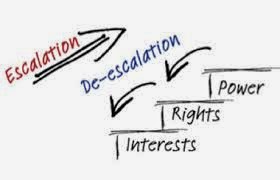
An objective mind has clear sight, which should be used to understand to an extent, the positions of all parties involved. However, pursuing a line of enquiry to understand each party’s interests is far more reaching into each party’s modus opperandi, the motives behind said modus and what they really hope to achieve in terms of outcome. Understand this, and solutions are never far behind. That said, when polarised positions have complicated matters increasing the distance between parties in any dispute, its important to use one’s understanding of common ‘all party’ interests to engage in the following process of resolution;

Landscape. Understand the difference between counter party interests and the drivers of conflict fuelling polarised positions.

Personalisation. Use the insights gained into the above to ensure that each party can connect on a personal level. It’s important to connect as people if the process cannot move past positions.
  

Bridge The Gap. Understanding each parties interests and what drives them. Map out where each party is and understand the reasons for the gap between each party’s position. Use this insight to connect each party with their common interests and aligned humanity to start addressing their differences for a win-win outcome if possible.

Changing party positions. Monitor and respond to each party’s positional change given some parties will be adversarial by design/nature and will change negatively as much as some will change positively. Negative positional changes can escalate a contentious situation with trust in you as the first casualty and positive change potential as the second. Be sure to assert common purpose and if there is no response to addressing negative positional changes. Also, be sure to suspend a negotiation if necessary to enforce a change in position by persistently negative parties.


Follow up. Parties, ultimately revealed with ulterior motives and have no real interest in a resolution should be removed from a negotiation once there is coverage of their relevant interests at the table. Its important to consider one’s credibility when making a decision on follow up to persuade or enforce a change using what ever is necessary to make the party see the gain for them in a common resolution. Such follow up could connect them with their real interests thus altering their position to one of collaborative from adversarial.


The above is far from detailed, but if we can simply focus on interests and not positions then the relevance of polarised positions becomes relegated in importance and impact when we all try to work together for a common future. After all, we live under the same sun, so why not try make the most of our time together; for time is a commodity we cannot get back!


Sources/Credits:


Pics:


Credits:

http://www.quotes-clothing.com/argue-person-renounced-reason-like-medicine-dead-thomas-paine/

Tuesday, 29 July 2014

Interest Based Negotiation, answering conflict with success!

Finding the “win-win” in us all!!


There is no doubt that the vast majority of conflict, whether it is in the office or on the battlefield is fuelled by misunderstanding and miscommunication between two or more parties. Of course, one can assume that conflicting positions produce conflict but I argue that the risk of escalation can be decreased and the probability of resolution increased if all parties actively look to reconcile their interests from the beginning through interest based negotiation.

Williams & Schneider in 1983 conducted a study on counter party negotiation techniques and found 4 different clusters of negotiator existed. The negotiator clusters were classed as ethical and unethical “adversarial” along with true and cautious “problem solving”. The results were startling! The counterparty in the study when asked to evaluate the style of the negotiator found the most effective negotiator to be “true problem solving” (72%) which is taking a genuine interest in the position and interests of the counter party and making a real effort to accommodate the interests of the counter party whilst protecting their own. At the bottom of the rankings was “unethical adversarial” (3%) which was defined by an aggressive posture and unwillingness to budge from their “position”.

So what can collaboratively engaging a counter party in a negotiation do for you? Seeking to understand your counterparty position, their interests that lie behind it and how their interests are impacted by your interests sets a negotiation on a more likely trajectory to success.

A well executed interest based negotiation technique can also:

Focus on best interests creating objective focus on best outcome, and not subjective bias driven positioning which often leads to failure
Addresses unethical behaviour designed to achieve leverage such as undercutting, non related blaming, discrediting, etc.
Un-fixes confrontational positioning by aggressive negotiators, thus becomes directional to collaborative outcomes.
Create a dynamic approach thus increases communication effectiveness and success probability through gaining best outcome for the collaborative negotiator who is assertive in IBN.


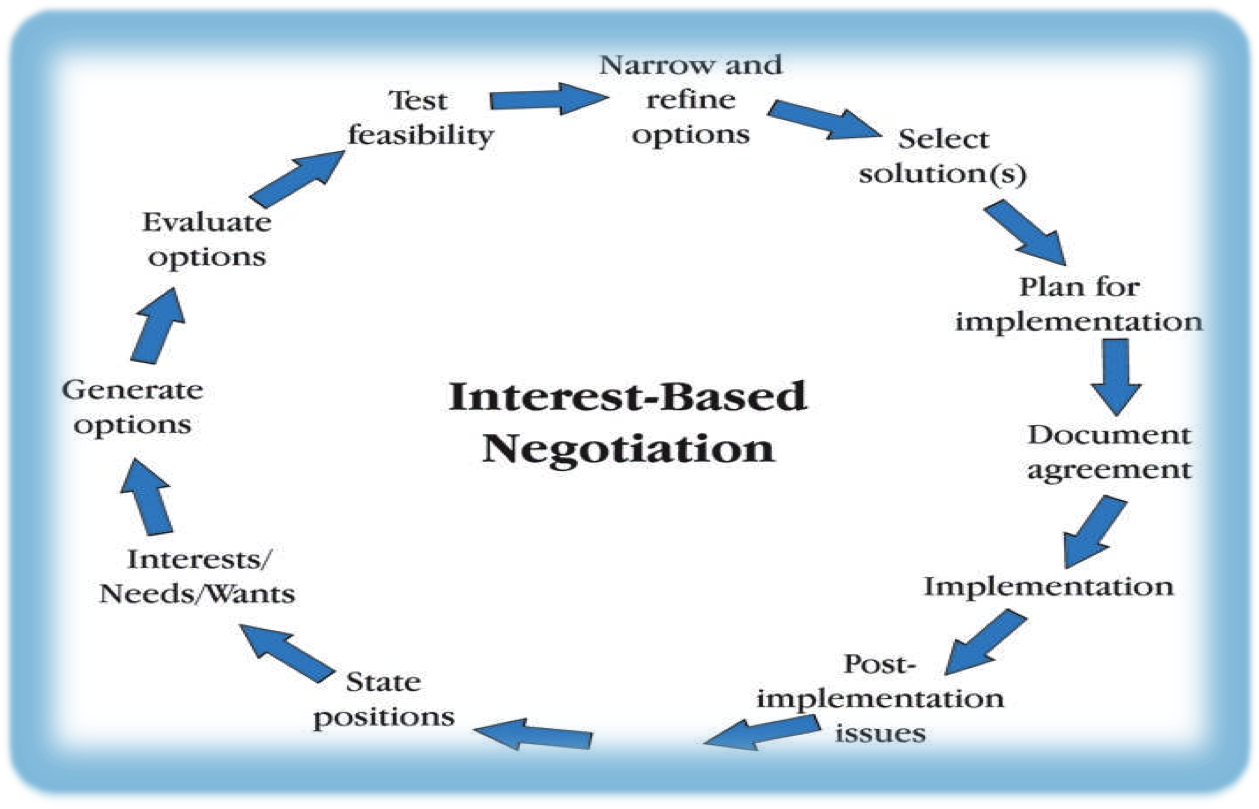
To get the most out ‘IBN’, I would submit the following be used as a process in any counter party negotiation:
  • Focus your Mind-set to be assertive yet collaborative. Clear your thoughts of unrelated issues and feelings, especially negative ones.
  • Address all party aggression with assertion by opening with a position of confidence leading to your statement of interests, not your statement of position which should remain open and unfixed until you have a clear understanding of your counterparty’s interests.
  • Identify your counter party misdirects by understanding their interest centre
  • Openly reconcile your interests to your conterparty interests for feasibility, which leads to credible counterparty acceptance and debunks hostile positions in-conflict with it
  • Be prepared to adjust your own “interest centre” if your own real interests are better served by such an adjustment.
  • If other party aggression supersedes acceptable levels, remember to never waiver tone of voice, increase volume to reassert one-self into the negotiation. Only do so if you can redirect to best interests and not inset positioning. If best interests cannot be refocused on, adjorn the negotiation rather then escalate into aggression.
  • When best interests are found which have being prioritized through the rationalization and comparison of all interests at the table, then a resolution can be agreed upon and documented including agreed follow ups.
  • Follow up on post agreement implementation issues and resolve on the basis of best interests being served for all.


With the collaborative approach to conflict resolution at any level in any environment, one can see how even unethical adversarial positions can be moved through interest based negotiation producing a “win-win” outcome. Concluding, I would suggest that in today’s conflict ridden world, maybe its time to abandon “win-lose” outcomes in favour of interest based negotiation which can bring all a better tomorrow in a manner, which can heal the wounds of today.


Sources/Credits

Williams & Schneider Results: Forbes  & Harv. Negot. Rev. 143

Interest Based Negotiation Chart: US Institute for Environmental Conflict Resolution

Pics: