Showing posts with label #Web Development. Show all posts

Monday, 20 July 2015

Cloud Technology; is it flexible enough for the “real world”?

If it’s really ‘all good’ in the Cloud, then why wait any longer?


Last week, I attended an “awesome” event hosted by AWS and their Co-Sponsor Intel in the ‘Silicon Docks’ area of Dublin, Ireland. The event appropriately named “AWSome day” was a whistle stop tour of AWS’s complex cloud offering that ranged from Compute Services like EC2 to Storage Services like S3, Elastic Block Storage (EBS), Dynamo DB plus others.

So after hearing AWS’s offering and some technical details about its platform, the following points struck me about AWS as something that one cannot overlook when thinking about how to structure one’s digital footprint in today’s world:


Availability – AWS has a highly robust and developed global network of availability zones, each one containing between 1 and 6 data centres, which provides uptime availability to a target of 99.99999999% as claimed by AWS on the day.

Reliability – In addition to the 11 availability zones that have sub zones (multiple data centres), there are 53 edge locations where “Route 53” DNS management and mapping takes place. Route 53 services ensure data is returned to a user as quickly as the nearest edge location managing the routing traffic can provide it.

Customisation – You can select exactly what kind of processing power you want, what kind of storage you need and what kind of access you want in configuration of your AWS solution. This allows for higher performance to be returned in cost effective manner given your needs are well defined.

Access Control – The ability to set policies by instance to regional level helps with security and business rule policies on information management (access) are useful also.

Size – The ability to scale up and scale down with AWS is apparently very easy and user friendly in its execution. AWS is over 10 times larger then its entire competitor list put together and thus is the cloud titan of today!

Big Data – AWS has big data stack providing services and enhancements for Big Data users of Hadoop and Spark. The underlying infrastructure in my view lends itself to parallelisation and good performance in big data jobs

So, it would appear AWS has gotten its business structured in a way that it could last a thousand years! Can it? Oh dude, I don’t know but what I do know is that migration onto the cloud needs to be done carefully and know that if you don’t do what’s right for your business, the costs involved could be enormous! Do it carefully, then the savings and gains will outmatch the risk you take so why not take some pre migration steps like these:

Risk Matrix – Create a list of elements involved in your IT structure both positive, negative and neutral and rank them by risk propensity (likelihood of it happening) to risk impact (direct impact of it happening on your business).  Map them out by these two elements in a cluster chart and see where they all sit, then group them by common thread see what risk picture your current IT structure & cloud solution presents.


Cost – Cloud provider pricing has a free tier these days, but when you exceed it, the pricing structures kick in and can become complex especially if you are using allot of services that present a value adding solution for your company. AWS is no different in this regard! Understand your proposition in terms of current state and costs along with project incurred state and costs. Not understanding your cost obligations may cost you dearly e.g. if you have a ‘freemium’ business model offering highly popular services such as SaaS over the web, footing the cloud bill based on throughput may come as a real shocker so be careful!

Purchase Choice – A strange thing about the cloud is that it appears they all offer the same service but they don’t. They may have comparable storage and compute services, but there are differentiation in many services and levels that should not be overlooked or assumed. For example, AWS has a neat service for using access keys call KMS (Key Management Service), Microsoft azure has Key Vault which can also simplify access key management. They work a little differently as the options for access management can vary, so it’s worth getting to know your preferred option in great detail.

A Cloud partner is a key business partner choice so investing in the selection of a cloud partner is a must to mitigate the risk a cloud partner can bring such as:

Financial insecurity – if your cloud partner is financially distressed and becomes insolvent, your stored data and services on the cloud are at risk of being lost or breached due to lack of maintenance by the provider.

Poor controls – some vendors have being found out for their poor controls where staff has used their work passwords on personal computers that were breached by hackers who then attacked the cloud platform successfully. A poorly managed Cloud provider with poor internal controls is a threat to your business!

Billing – the nature of cloud platform billing often sees careful customers run low bills. Budgets are based often on time constrained accountants who use last years spending patterns to set budgets. Be aware of your traffic and all triggers used in cloud billing like storage, V/M use, DB instance use, etc. The resulting shock in bills for successful business campaign could financially distress your company especially if you bundle free services in your offering.

Downtime – Even AWS has down time, which costs a whole lot of money for its customers. That said; its downtime is very low compared with competitors and in-house solutions in terms of company wide crashes.

Security – With platforms, there is a race between vendor and hacker to stop/seek a breach! Staffers are targets for access codes, the platform is a target for remote attacks and I’m sure there are other areas where this battle continues between vendor and hacker!

As I headed home, I realised the AWS has become a leader in cloud technology because they never lost sight of what the customer needed. With a little time and investment in your business future, you too could be on your way to the cloud joining so many successful established and start up businesses…

What do you think? Are we putting our heads into the cloud and seeing more clearly or are we for the birds?? Leave a comment with your opinion...


Sources/Credits:

Pics;

AWSome Day hosted by AWS bringing the audience on a whistle tour of AWS’s cloud offering. *2 Pictures.
           

Credits;

AWSome Day hosted by AWS bringing the audience on a whistle tour of AWS’s cloud offering.


Monday, 25 May 2015

Calling all Word Press Ninjas – Recover Your Word Press Site!!

Getting back into your website’s back end…


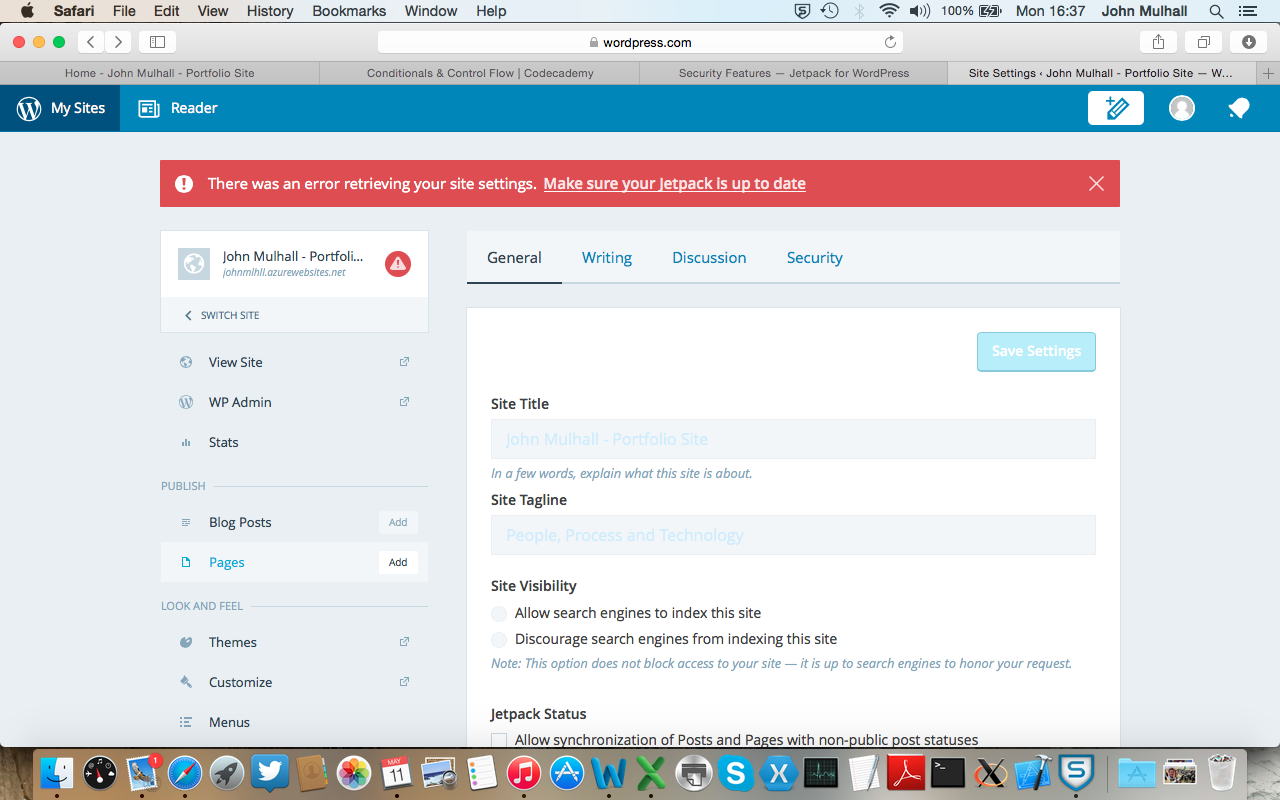
Ever get locked out? After being unlucky enough to have being hacked recently, my Jet Pack plugin kicked in with a full lock down, where I apparently was locked out of my own site and did not know what to do?? So as all good techies would do, Google.ie was my first stop and then JetPack customer support where a helpful chap called Ryan worked with me on a trouble shooting regime to try and resolve my lockout issue.

My IP address was not “whitelisted”, which allows your home IP address to be accepted by Jetpack if it uses the “Protect” element to lock down your site against a particular IP address that is trying to gain unauthorised access to the site’s back end. I never “whitelisted” my IP address which is a big mistake people! You can whitelist your IP address by doing the following:
  1. ·      Set up and/or log into wordpress.com (different to wordpress.org). Select “My Sites” then change site to the affected site. Remember you need to have JetPack installed and centralised management activated for your word press “remote” access to work.
  2. ·      Go-to “My Sites” and then “Security” tab to select the tag for whitelisting IP addresses, inputting your IP address, then clicking ok.
  3. ·      Once done, you should be able to get back in and administer your site should you have a brute force attack in the future.


If you are unlucky like me and didn’t have a whitelisted IP address PRE hack attack, you need to do the following as a recommended approach to resolving the issue:

Check your email smtp (outbound) email server details on your email (if patched into your computer) to make sure they are not deleted as part of the lock down.

Then…

Goto wordpress.com and log into “My Sites” and then “Change Site” to the affected site. Go to the security tab and whitelist your IP address.


Then…

FTP into your site back end on your hosting server or find your ftp hyperlink on your cloud provider’s Web App page. Remember your login and password will be different to your front end details so click on “download publish profile” (on Web App Dashboard page) to see your “ftp” details for login, which is usually the first part of your email address and a very long password.

Go to wp-config and if you have JetPack installed, define your whitelisted IP address by inserting “define(‘MY_IP_ADDRESS_OK’, ‘123.22.343.76’)” under the other definitions that define the connection string (database connection, etc). Click ok, and restart your site to allow the changes to take affect on the frontend and then try logging in.

Another way (pre hack) to protect against brute force attack is to modify (or create) via FTP login a “.htaccess” file for the back end login page where the attack will likely be focused. The hack in my case seemed to corrupt word press with view taking control of the back end resources. I noticed data spikes (outbound) on Azure when I was not using the back end due to being locked out.


Another learnt lesson is to get a clean set of site backup files and copy them from the Updraft (offline) directory to a safe location in the event of a catastrophic site attack where operational back up file sets are corrupted. Repeating this at every development milestone is a good idea also so you have a clean backup file set should a hacker do catastrophic damage to your site without you even knowing it, thus substituting tainted backups for earlier versions that are clean.

I guess the lesson is the same as the unofficial motto of the boy scouts, which is “always be prepared”. Some main take away points are as follows:

  • a)    Whitelist your home IP address via Jetpack OR Word Fence for your Word Press Website
  • b)   Use a backup plugin like Updraft to back up your website and store a clean copy at all developmental milestones in a secondary “offline” back up folder that is not linked to the one used by Updraft. That way, if you get hacked, you have a clean file set should the Updraft folder contain only tainted file sets, which will most likely be the case.
  • c)    You can whitelist your IP address via Jetpack directly whilst you have access to your site’s back end or if denied access; via FTP altering the wp-config file.
  • d)   A good idea is to copy your webpages onto .rtf documents (flat files) so your content is copied off line for the same reasons (corrupt back ups) as in point b.


For Word Press and Plugin developers, I would advise the following:

  • a)    Develop two-step authentication for the login page as a core feature of word press. The core is vulnerable via theme and plugin weaknesses, which needs a core security feature such as two-step authentication.
  • b)   Testing cooperation between providers hosted by Word Press to iron out any vulnerability from plugins, which do the same thing on a site.
  • c)    Have a Word Press feature that allows Word Press Support to decouple all plug ins, test the site core and every plug in for bugs as they recouple them to Word Press’s site core, whilst keeping the site running. Using the site Admin credentials to download the site into a test environment for this purpose may hold the key.


What the experience has thought me is a valuable lesson in preparedness, backups and contingency plans for keeping a word press site running as intended. The need to restore from primary backups via the likes of Updraft is as important as catastrophic site recovery from secondary backups like independent backup folders and then site rebuilds from page templates (including a plugin and associated file lists). They all matter equally, so don’t get caught after the fact like I did, start your site’s contingency planning today!


Sources/Credits:

Pics:


Credits;


Email Server Details – Article with all major services:
http://en.kioskea.net/faq/9166-smtp-imap-and-pop-server-settings-for-major-isps

Monday, 27 April 2015

Cloud Technology… is it really here? Well is it?

Solutions are becoming more streamlined, but where is it all going?


Last Saturday saw me at a Microsoft Azure “boot camp” where I chatted with some very talented industry professionals and listened to their opinions on the “new” Microsoft Azure! It was worth my while rising early on Saturday to go there and hear some of Microsoft’s senior Engineering talent talk about the new Azure and how it will make development life easy from Websites to MVC web Apps to Cloud Services. Impressed by their presentations, it got me thinking about where Cloud is going and how Microsoft’s latest offering in high level terms is similar enough to that of AWS in particular given its notable improvements in virtualisation functionality and an impressive ease of development which AWS should take note of in my view.


Whilst Microsoft, AWS and all cloud computing competitors have put allot of thought into their offerings, differentiation can be difficult thus deciding what is good for you and/or your business can be a hard task for even the informed developer and/or business owner.  There is no doubt that the major players have a good support structure in place to help businesses decide but ultimately, it comes down to the cost benefit of the value proposition when placed against a company’s need for consistency, availability and partitioning of transactions in their data management plans. Knowing what you want in detail before looking for value in a Cloud partner is key to getting what you need to be successful in your use of cloud computing! In short, know your data management requirements inside out and then go look for a cloud provider!

My mind then moved onwards thinking about the future and how these marked improvements will feature in marketplace and competitor reaction as the competition cycle keeps on turning. A couple of things came to mind, which I would like to share with you as possible “watch that space” points for the short to medium term future:

Data convenience: As in life, there is a continuing shift in business towards convenience.  A hallmark of cloud systems in PaaS and SaaS in particular is that it’s controlled more by the provider then you as the customer. As convenience is the keyword, you don’t have to do your own updates, manage your security, etc. IaaS is a little different in that your use of virtual machines requires more maintenance from your IT guys but offers great flexibility at the cost of a little convenience. The details make it a powerful product type, in which AWS and Microsoft are key players.

Trust: Given the high performance rates and availability track records of the major providers to-date, trust is building in cloud computing that is leading to more and more “trusted” use by consumers and business alike. These increasing usage levels has higher business and operational risk weightings, which has being retained or off the table for any cloud solution in the past. Trust earned is making convenience a unique selling point for cloud solutions!

Databases: The industry’s wary welcome of NoSQL in particular is starting to mature into an embrace that sees database and network storage solutions develop at a faster and faster pace. The big sell for SQL and relationship databases (RDBMS) has always being its “relational” features in SQL that allows analysis and joins with data in schema tables to happen gleaning insights for the business who uses RDBMS’s wisely. This has being the way for many decades since Oracle V2 with NoSQL now getting the positive attention it deserves. Its development into cloud has given it a good grounding for large network benefits that are getting better and better by the day, from large parallel computing jobs where huge amounts of data are processed in a short period of time to the narrowing of the bridge between SQL (i.e. Relational) and NoSQL (i.e. Non-Relational). The latter is the more recent development with great improvements reaching market like Drill and Data Lake, which are effectively narrowing the relational and non-relational divide making modelling, management and SQL “like” querying more integrated, useful and flexible to user needs. This handing of power into the hands of the user is why I think database and storage solution technology will eventually migrate into a single interface and storage management system? Who gets there first with a fully functional “one stop shop” for your truly centralised storage solution needs from one user interface? Well that’s anybody’s guess!!

Security: Security is always an issue when you are ‘trusting’ your cloud provider to take care of your data. The ability to get hacked is always present but so is the growing and evolving expertise of the cloud providers who have shown a capability that is certainly making “hacking” a more difficult and faster changing occupation. It’s a never-ending battle between hacker and provider, which indicates to me that the ability to maintain data integrity from hacking will be a keynote element in the progression of cloud technology. Consider this, if a cloud technology titan like AWS could be hacked and brought to its knees, the consequences in business terms would be catastrophic for whole industries, never mind whole companies!


The responsibility that cloud providers take on in the war against hacking is a grave one and to date, their success lies in the preservation of their network’s integrity, which has opened an impacting gateway for society’s data management needs! Least they fail; we all fail… best they succeed and we all succeed in maintaining a key part of our infrastructure in society’s continuing journey!

So if increasing trust is matched with more developed risk management approaches in using a fast developing platform for our data needs, I submit that our flexibility as a society can rest upon such an axiom and enable great things in the years to come!

Do leave your opinion on cloud technology in the comments section… I would love to get your take on the newest arrival to our digital world!


Sources/Credits:

Pics;


Credits;


Microsoft for its presentation of Microsoft Azure during the “Azure Boot Camp!”