Showing posts with label #Time Management. Show all posts

Monday, 19 October 2015

"A Raving Success” - Planning for Performance

Learning from today’s failures in order to achieve tomorrow’s success


Lisa Morton once said “Some say I'm an overnight success. Well, that was a very long night that lasted about 10 years.” Her point is well made and recurring throughout time due to a fact, which all successful people know. All success is predicated by a much longer period of trying, failing, trying and trying until the stars a-line and success happens.
In my own career, I have worked with 3 start ups thus far and can say with a degree of certainty that Dublin’s startup scene is currently one of the most vibrant, youthful and committed in the world today! As with elsewhere, the formula for success is still elusive and first time entrepreneurs seem to have a consistent expectation for success. I personally think it’s admirable but from experience know that the high failure rate is down to many things, which are covered in some of my prior posts. What is as important as the environmental and constituent elements of a new business is the expectations of the entrepreneur and how they go about putting it all together.

Here are some points I have noticed in my own career to date, which bear merit to the new business entrepreneur setting out on the road to success.


Expect to succeed in business, not in your business! Contextualise your mindset with a high fault tolerance knowing that whilst you expect your business to succeed, it is likely to fail on your first try as an entrepreneur. This does not mean you should fail in business. Segregate your career as an entrepreneur from your new business and be prepared to start again. Accept failure as part of the company lifecycle, which will drive your career as a business owner. By doing so, you can be less burdened by the ability to fail, thus focus on the path ahead to success.

Flexibility is key, assertiveness is its vehicle! They say ‘keep an open mind, but don’t let your brain fall out.’ The entrepreneur should remain mentally flexible and open to comments, suggestions and criticisms. They should vet them for positive intent on behalf of the sender and deal with them assertively even if it’s negatively intended. To assert oneself positively even in a negative situation is to establish a stronger position based on one’s interests rather than the position they hold. A conversation that starts off as negative, can with an assertive reaction by the entrepreneur finish very positively a couple of minutes later.


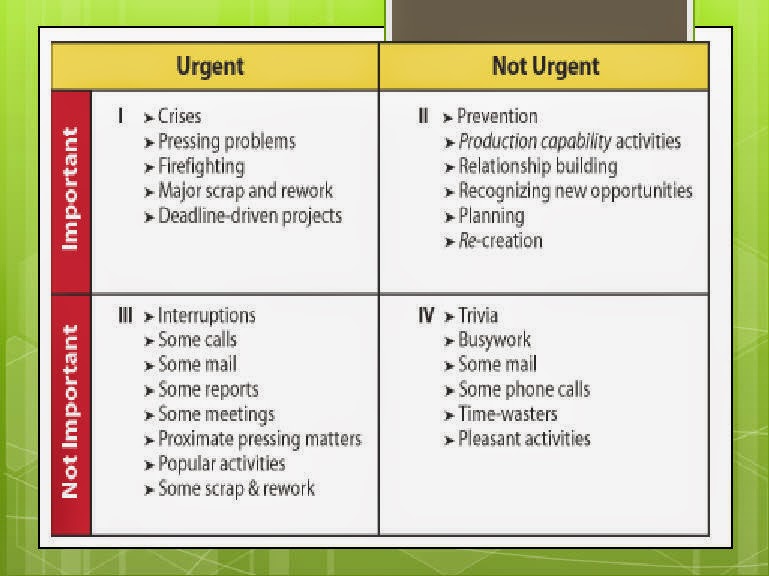
 Manage your time or it will manage you out of business! I submit that time is equally as valuable a commodity as money to the new business entrepreneur. Manage time on a bootstrap basis with strict discipline around time management techniques like 7 day forward scheduling, setting time for “urgent” tasks where incoming emergencies need to be dealt with and important outbound tasks that can be proactively planned. Tasks that are not important or urgent can be delegated or automated. Never underestimate how much time is needed to do emails, answer calls, engage employees in their issues and so on. This is time you need to plan for. Augment your schedule as you learn from experience how long it actually takes. I always put time aside for my breaks, checking email AND planning my time for the following day and week ahead.

Manage your work life balance -  Work hard, stay committed and do what you need to for your business. However, there is a limit that needs to be respected. Keep a tight reign on your time as overworked and exhausted can put you out of business as quickly as anything else, especially when your own judgement and performance becomes impaired by fatigue.

Start with the end in mind - It’s too easy to have a great idea, start a business and get lost in the reasons why things can’t be done, cope with them and come out the far side a different person with a business you never wanted at the beginning of your journey to success. Success does come with a price but don’t prepay for it with a lack of consideration for things normally associated with larger companies like organisational structure, leadership practice, process management, documentation of work practices and company culture. IF you intend to have a business success with a hierarchical company culture, then match that intent with an appropriate business idea and plan. Don’t expect to succeed in a startup that requires a team effort from founders, employees and interns building services or developing specialist products that require expert knowledge using a dictatorial leadership style, chain communication practice and a wish for a “command ‘n control” hierarchical company culture. Match your “style” with you business plan as if you do not, the secondary issues that arise from this mismatch are likely over time to destroy your business before it really begins.


 Protect your “interests” - As in a prior point, remaining flexible to protect your interest in a relationship context is key to success as is protecting your interests such as intellectual capital, product schemas and physical goods patents. Registering trading names, brand names and trademarks are an important part of the road to success. Don’t build a castle of success for someone else to walk in and take the keys because if you let them, they will come when there is money to be made!

From idea to vision to practice to culture - people come first! - A start up of any kind is more likely to succeed if Founders surround themselves with like minded people. There is synergy with 3 Founders and 6 Employees all being givers and collaborators gelling in a near unconscious way to form the nebulous adhocracy company culture before they even write a single operational policy document. Deceiving any one of those people who are not like you into “becoming you” is an act of arrogance that will ultimately lead to compatibility problems. Given the profound impact employees and founders alike have on the potential of a new business, such an issue can lead to disaster if left unchecked.

There is no exhaustive list for becoming a successful entrepreneur. Many “feel” their way through a process of “on the job” learning as they go to become successful and in many cases are blessed with good luck to help them on their way! What is clear though is that those who learn from the mistakes of others, clearly understand who they are, what they want and how they are going to get it will stand a higher chance of success than those who are unclear in these areas. As the old saying goes “give a man a fish and he feeds his family for a day, show a man how to fish and he feeds his family for life”. With entrepreneurship, the trade craft can be learnt without drowning in the process. Do you agree? Leave a comment today...

Sources/Credits:

Pics;


Credits:


Monday, 5 January 2015

2015, OMG!!!... How did all that WORK land on my desk???

Time managing your way back to work through January…


So, to start, I would like to wish everybody a Happy New Year! May good fortune find you in 2015! However, in order for that good fortune to see you, you may need to dig yourself out of the mountain of work that has enveloped you and your workspace when you were off for the Christmas!! It’s no easy task especially when so many financial year-end protocols arrive on the slay-tails of Santa Claus and his band of merry reindeers!!

Indeed, time management is one of many things I have had on my New Years pledge list for many years, which for me sits at number 7 this year. Here are my current top 7 New Year’s pledges:

  • 1.     Get a job (that actually pays)
  • 2.     [Or] Get a job (that someone else pays me for)
  • 3.     Do very well in all my software exams and create kick ass code in my applications
  • 4.     Learn 2 new coding languages in depth in addition to front-end languages/protocols such as HTML and CSS
  • 5.     Secure a slot for the next stage of my software education
  • 6.     Network and grow my “personal brand”
  • 7.     Manage my time better 


My list goes on and on but you can see, boredom will not be a problem! What is a problem is getting anything done given I have so many priorities, schedules and unknowns to account for on a daily basis. If this is sounding familiar, then you are in the right place! Here are some of the things that have worked for me when sorting out my time trying to get much done at once.

Working assumptions:

·      Doing too much at the same time will see nothing done.
·      Last year’s January pain clearing the Christmas backlog doesn’t have to be this year’s pain.
·      Trying to please everybody at once is the recipe to failure, not success!

Time Management Tips:

·        a) Quantify your work: define how much of it is important (i.e. can be proactively planned; is  important and will achieve a constructive goal reducing collateral tasks due to its completion)
·       b) Quantify your work: define how much of it is urgent (i.e. is reactively responded to; is critical in nature and can’t be overly planned due to the stressed urgency placed on it by the sender)
·        c) Quantify your work: define how much of it is not urgent (is reactively responded to; not important; can be shared, scheduled or returned depending on circumstances)
·        d) Quantify your work: define how much of it is not important (low level work that has being scheduled by you but can wait until higher priorities are resolved)

 Diary your work: Assign priorities ranking the work/tasks to be done by importance and estimated time needed to complete them.

·        Diary your work: Schedule operational tasks up-to 7 days in advance spreading out the workload detailing a realistic schedule using the diary on your computer, tablet and/or smartphone.

·        Diary your work: Task Schedules need to be kept real, so include things like lunch breaks, 15 minutes in the morning to review your schedule, and 10 minutes in the evening reviewing tomorrow’s schedule. Also, keep a gap of free time between “important” task blocks and “urgent” tasks (I use 30 minutes as a gap) to account for task overruns.

·        Assess your performance: Accomplishments in time are where you create and add value, so if you are getting blocked by unseen work tasks coming out of nowhere and promising to go away if you drop everything and address them, then you need to diagnose the source of these unseen tasks and address them as inhibitors to your own performance.

·        Don’t work late to clear backlogs for more then 3 days in a row. You have a life whereas your boss has his or her priorities. Despite the ignorance around performance, stress and fatigue that inexcusably exists today, you need to remember your health is yours alone. In turn, your rested self will perform at higher levels achieving and contributing more value to your company if you stick to regular hours of employment and only work late on occasion; a maximum of 3 successive days should be the limit.
  

So gleefully, you can put order to chaos and charge ahead into January with a plan and approach to the month that will set you up for the year. Good time management as I have found out over the last decade in particular is about insight and discipline. You cannot achieve your goals without both traits working together in a practiced symmetry that drives your routines, direction and successes in both work and in life!


Credits/Sources:

Pics;


www.dreamstime.com       


Credits;