Time managing your way back to work through January…

So, to start, I
would like to wish everybody a Happy New Year! May good fortune find you in
2015! However, in order for that good fortune to see you, you may need to dig
yourself out of the mountain of work that has enveloped you and your workspace
when you were off for the Christmas!! It’s no easy task especially when so many
financial year-end protocols arrive on the slay-tails of Santa Claus and his
band of merry reindeers!!
Indeed, time
management is one of many things I have had on my New Years pledge list for many
years, which for me sits at number 7 this year. Here are my current top 7 New
Year’s pledges:
- 1. Get a job (that actually pays)
- 2. [Or] Get a job (that someone else pays me for)
- 3. Do very well in all my software exams and create kick ass code in my applications
- 4. Learn 2 new coding languages in depth in addition to front-end languages/protocols such as HTML and CSS
- 5. Secure a slot for the next stage of my software education
- 6. Network and grow my “personal brand”
- 7. Manage my time better

My list goes on
and on but you can see, boredom will not be a problem! What is a problem is
getting anything done given I have so many priorities, schedules and unknowns
to account for on a daily basis. If this is sounding familiar, then you are in
the right place! Here are some of the things that have worked for me when
sorting out my time trying to get much done at once.
Working assumptions:
·
Doing
too much at the same time will see nothing done.
·
Last
year’s January pain clearing the Christmas backlog doesn’t have to be this
year’s pain.
·
Trying
to please everybody at once is the recipe to failure, not success!
Time Management
Tips:
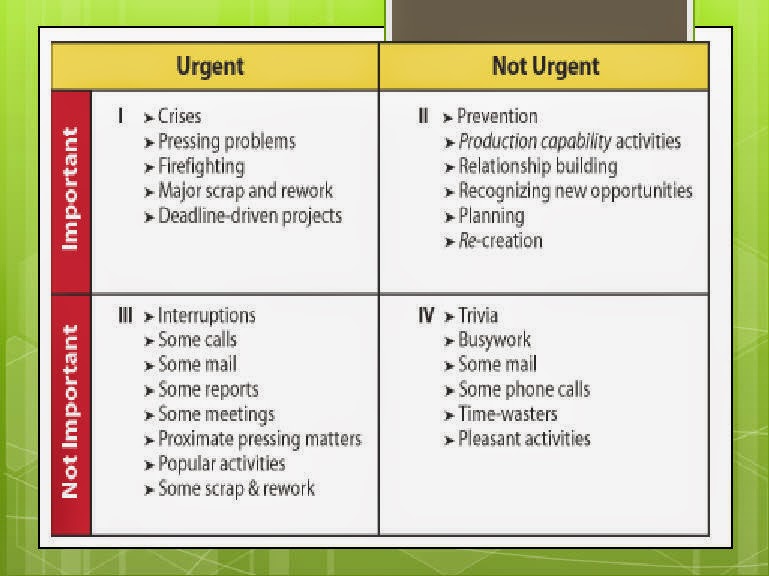
· a) Quantify
your work: define how much of it is important (i.e. can be proactively
planned; is important and will achieve a constructive goal reducing collateral
tasks due to its completion)
· b) Quantify
your work: define how much of it is urgent (i.e. is reactively responded to;
is critical in nature and can’t be overly planned due to the stressed urgency
placed on it by the sender)
· c) Quantify
your work: define how much of it is not urgent (is reactively responded to;
not important; can be shared, scheduled or returned depending on circumstances)
· d) Quantify
your work: define how much of it is not important (low level work that has
being scheduled by you but can wait until higher priorities are resolved)
Diary
your work: Assign priorities ranking
the work/tasks to be done by importance and estimated time needed to complete
them.
· Diary
your work: Schedule operational tasks up-to
7 days in advance spreading out the workload detailing a realistic schedule
using the diary on your computer, tablet and/or smartphone.
· Diary
your work: Task Schedules need to be
kept real, so include things like lunch breaks, 15 minutes in the morning to
review your schedule, and 10 minutes in the evening reviewing tomorrow’s
schedule. Also, keep a gap of free time between “important” task blocks and
“urgent” tasks (I use 30 minutes as a gap) to account for task overruns.
· Assess
your performance: Accomplishments in
time are where you create and add value, so if you are getting blocked by
unseen work tasks coming out of nowhere and promising to go away if you drop
everything and address them, then you need to diagnose the source of these
unseen tasks and address them as inhibitors to your own performance.
· Don’t work late to clear backlogs for more then 3 days
in a row. You have a life whereas your boss has his or her priorities. Despite
the ignorance around performance, stress and fatigue that inexcusably exists
today, you need to remember your health is yours alone. In turn, your rested
self will perform at higher levels achieving and contributing more value to your
company if you stick to regular hours of employment and only work late on
occasion; a maximum of 3 successive days should be the limit.

So gleefully,
you can put order to chaos and charge ahead into January with a plan and
approach to the month that will set you up for the year. Good time management
as I have found out over the last decade in particular is about insight and
discipline. You cannot achieve your goals without both traits working together
in a practiced symmetry that drives your routines, direction and successes in
both work and in life!
Credits/Sources:
Pics;
Credits;