Monday, 13 April 2015

Sub Culture, teams and Leadership... Is it a good idea?

Building a better tomorrow or simply swimming upstream?


In our earnest effort to be good leaders, we often think of a utopian paradise where we are loved and everybody looks forward to the start of each working day as much as they are sad leaving their extended family at day’s end. Nothing wrong with this vision, but we often allow good intentions to overly influence our leadership style, our strategic direction and where we think we can go with our team over time.


This can be counter productive and result in disaster if not checked early enough so can apply a more discerning approach to consultative leadership? Being discerning, we need to focus on the details of our leadership and the path ahead through things like:

Team Composition. What type of team do we have? Are the personalities takers, matchers or givers? Are there any functional or dysfunctional Alpha characters? Are there any passive aggressive types on board? Who are the social leaders and are they consistent with your leadership style and compatible with your forming vision for the team’s culture/operating state going forward?


Company Culture. What is your preference for an operating environment and company culture?? Is this combined vision (with your leadership style) to be found in the company leadership handbook, actual company culture and business practice??? Does the meld of all three elements into company culture suit your vision for an operating environment or do you have to create a sub culture for your leadership plans??

Management Practice. Are management ‘laissez faire’ in their actual practices leaving you free to practice leadership as you see fit or do they insist on a particular style?? Do management micromanage you, mentor you and/or coach you??? Will their practices impact your ability create a cultural connection for the team or instantiate a sub cultural environment for you and your team to operate in?

Social Hierarchy. Where do you and your team sit in the company’s social hierarchy structure? Will this impact your leadership plans in creating a consistent working environment to allow the group process to form, storm, norm and perform to set goals and objectives?

These are some conditional elements to consider when you are thinking of creating a productive sub culture in your company that suits your leadership style. Its context, acceptance probability and operational/cultural impact need to be understood in detail before proceeding.

If you find your company’s culture and management practices are consistent with your vision for leadership and a resulting operating environment, then you are in the right place! Well done, proceed with enthusiasm and create a sense of ‘we did it!’

If you find yourself upon reflection in difficulty, learning that management are negative or non responsive to your pitch, where you will drive changes with your team in approach, practices and procedures with a distinct sub culture instantiated, then don’t despair you are not alone! 
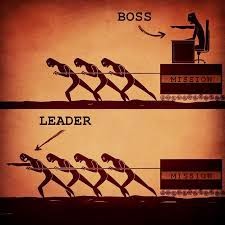
Whether it’s a case of management not understanding, not caring or disapproving, I would surmise that your vision may highlight a lack of vision on their part, which can happen for many reasons that have little or nothing to do with you. One needs to think of the follow on approach in terms of these questions:

  1. ·       After pushing for an answer with management, is the response consistent with support or no support bearing in mind that the absence of expressed support is “no support”?
  2. ·       Is the company culture likely to respond aggressively to the sub culture creation (i.e. giver taker culture clash) where your team’s social status is perceived in the company as “weak” due to the collaborative aspects of your leadership and environmental maintenance?
  3. ·       Are there any political considerations above the ‘normal’ limit of office politics where your plans, goals and objectives are perceived to interfere with powerful people or functions within your organisation?
  4. ·       Are your goals unrealistic to the environment you are in? After careful analysis and consideration, are you being asked to build ‘castles in the sand’?
  5. ·       Do you think your direct manager is uncharacteristically keeping his or her distance from you and your plans (not seeing inter company support of you to other company departments and members by your manager can qualify as keeping one’s distance)?

If you are thinking “yes” to all of the above, then the chances are quite real that your leadership style and vision may well fail due to a lack of suitability with your company’s practices, culture and attitude towards what you do and how you want to do it.


What to do? You could solicit direct counsel from your manager as to how he or she wants you to resolve the team/department situation and leave your effective zone of leadership to carry out the resulting instructions. However, in the long term your efforts will be in vain, as you will become a ‘proxy leader’ and not likely to gain the credibility from staff you need to succeed. Best advise if you are hitting a “yes” to those key questions is to find another position within the company or another company that is more suited to your cultural needs and leadership style. I submit that finding a good cultural fit is more important for the incoming employee then it is for the company as we perform best where we belong, not where we are employed! Marry the two together, and you enter a win-win relationship with your employer!


Great leadership starts with great vision, which in turn starts with seeing the situation for what it is, enacting a picture of what will be and then mapping the key milestones to getting there.  If you can do this, then you are on the right track. If you can’t see this or your company wont allow you to, then find another company who shares your passion for doing it right. What’s “right” depends on finding those of like mind to surround you! When you do, you will do great things!!


Sources/Credits:

Pics;


www.unsplash.com (Rayi Christian Wicaksono)


Credits;


Monday, 6 April 2015

Cloud Platforms - What will yours be?

Reading between the lines in choosing between 3rd Party Hosting, PaaS and IaaS…


I am just finished by University Exams in Software and Cloud Technology ergo my return to blogging after a short break for the exams. In this intermittent period, my reflection led me to what I’ve learned about cloud technology and what impact it likely has on my plans for the future. On that note, I definitely see a role for cloud technology but even after studying cloud technology in detail, the vastness of cloud is truly mind-blowing in terms of its potential. Even loose comparisons are a daring venture when evaluating platforms, which gets even more daring when comparing providers.


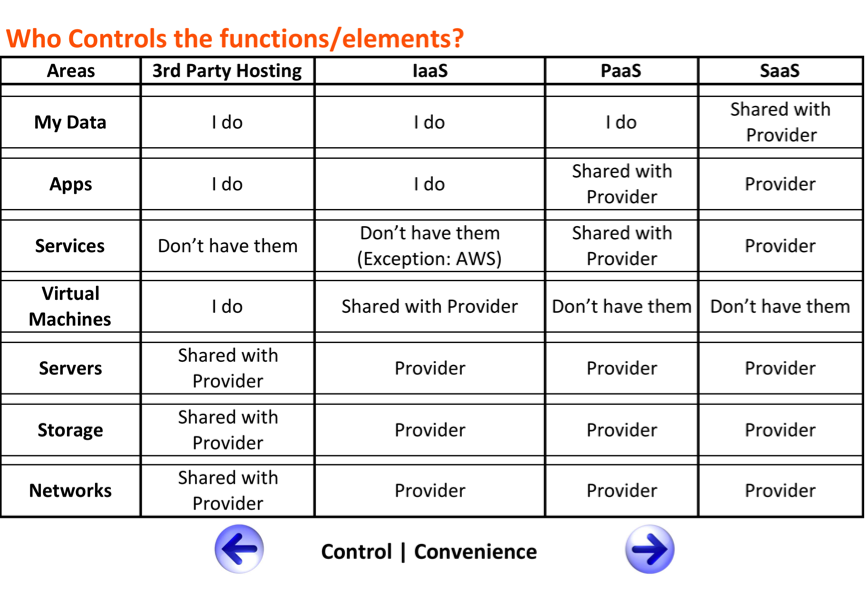
So if I were asked to describe cloud platforms I would give you the following synopsis as a rough high-level guide to what the platforms are from a control perspective:


It’s not easy thinking of what we want on complicated topics but if we think of the different platforms in terms of single statements, we could describe them as follows:

3rd Party Hosting = I want to host all my applications, services and data on somebody else’s servers and network sharing my own security and application maintenance/storage/etc. E.g. Blacknight (https://www.blacknight.com).

IaaS (Infrastructure as a Service) = I want to be free to host my own applications; services and data on someone else’s network, storage and servers, have good scalability and access to useful infrastructure tools and services; which allows me to package and deploy anything I want, without worrying about infrastructure maintenance from a V/M, server, storage and network perspective. E.g. Amazon Web Services (aka AWS http://aws.amazon.com).

PaaS (Platform as a Service) = I want to develop applications using someone else’s services, servers and storage not having to worry about maintenance so I can focus on development. E.g. Google App Engine (https://cloud.google.com/appengine/).

SaaS (Software as a Service) = I have a need for an application that I don’t want to buy as a client. I want to use it only when I need it and not worry about maintenance of the backend. I am comfortable sharing my data with the provider through the front end. E.g. Facebook (https://www.facebook.com).

So knowing what they are, its easy to see that the suitability for business needs can be diced and sliced for any business solution of any size, but in general terms the following can be held up as a general rule of thumb when looking to source a “cloud solution” for your needs:

a) 3rd Party Solution = Tech Savvy SME solution, an entrepreneur’s best friend!
b) IaaS=A tech savvy fast growing enterprise of any size seeing infrastructure as a bedrock for building and deploying scalable solutions from scratch upon.
c) PaaS=Development orientated for developers, enterprises that have a digital presence of any size and want to focus purely on scalable development rather then diversions into Ops or infrastructure maintenance.  
d) SaaS = Any business of any size who want to use services free or at lost cost that support its business development.  Its application based where the trade off is information inputted into the web application is shared with the provider.

When we think of cloud today, we have three titans that dominate the industry between them. AWS is by far the largest, with Google App Engine and Microsoft Azure coming up as leaders in the chase group to AWS.

One of the interesting points of note when one becomes established in the cloud is the increasing worth of the open source software movement’s offering through “Open Stack” (https://www.openstack.org/software/). It’s technically challenging to begin with but when mastered, it offers quick switches to other providers when outages happen or one wants to switch for other reasons (price rises, etc). It’s worth noting that big names like Google App Engine, Microsoft Azure and even AWS have outages that brings down your service, so when you are doing a risk review of your business network architecture creating a line on your risk register for cloud provider dependency, you now have some good options for risk mitigation through Open Stack.


Did you ever get a headache comparing platform providers? I know I did! Choosing four providers, Blacknight, AWS, Azure and App Engine compiled with some metrics gives you the following flavour of what to expect to get started in your cloud provider search:

Table 2 Metrics - Development & Pricing


Table 2 Metrics - Storage & Services

*Note: Every attempt has being made to make these comparison tables accurate as of May 2015 noting it is not exhaustive. There are comparable providers of cloud services that are not included in this list.

As you can see, even a focused attempted to get comparable prices, services and attributes of cloud services is very difficult to capture in a blog article such as this, but hopefully you will have a starting point on choosing a cloud platform.

It comes at approximately 10% of the price of in-house solutions, has “big company” applications, services and attributes that allow the smallest of start-ups to compete on level digital playing field. Pricing is inherently linked to volume and usage, which makes revenue-generating activity on your network a profitable venture given the lower and more reliable overheads incurred with Cloud.

On the downside, there are outages outside of your control, but they are rare and often very short.
There are also security issues for companies dealing with more sensitive data from propriety data upwards, which present day cloud solutions may not be suitable for. Also, you can become a victim of your own success if your website, applications and platform traffic increases but your revenue generating activity does not keep pace. Your income over expenditure gap can quickly reduce leaving you with a big bill and not the means to service it.


Cloud technology can play a part in your digital solution and as the technology continues to improve, innovate and augment, more and more opportunities for cloud will appear with the value proposition clearly in your hands. Why not start today and see what cloud tech can do for you? I know I did and I have no regrets!


Sources/Credits:

Pics;


Credits: