If at first, you don’t
succeed… DON’T lower your standards!

They say “when you surround yourself with like minded
people, you can do great things!” Often, we think of this in a startup context,
but whether you have 2 employees or 200,000, this saying is equally as
important for any company to enjoy continuing success and longevity.
Too often, the quarterly culture sets in and the
mindset is over focused on “pleasing investors” with management lenses fixated
a high level of revenue growth when the real casualty can be a longer term view
of the company and its ability to grow and/or even survive past the short term
tenure of serving senior executives and/or the next earnings call.
Twitter recently decided to clean house and
unceremoniously laid off 8% of its workforce in a cost cutting measure. Some
previously valued members of the team were laid off by tweet. As a developer,
would you work for a guy who can lay you go by tweet? #NoThanks ! Twitter’s
misfortune grew from the bad PR they got for their poor handling of the lay
offs with a “poor earnings” quarterly call, which saw Twitter stock drop 20%
on the markets. The fixation on pleasing investors apparently lead to overfocus
on costs. Even with this cost reduction focus, Twitter still took a huge market
hit on their below expectation revenue numbers. The reasons why didn’t matter
apparently so how does this resonate for sustainability at Twitter?
Creating value requires a different mindset to the
austere process of cutting costs, which is what Twitter must now be challenged
with. How can Twitter raise revenue levels whilst at the same time be
reasonably cost conscious? It seems like a big project proposal is on the way
but what is actually lacking is a connection. I submit it’s not a matter of
cost, it’s a matter of structure and resources. In short, if you want to grow,
you need to harness the power of your people and connect them to innovation!
So, taking the ‘Twitter Challenge’, can your company
realign itself to organisational structures, business practices and a company
culture that has the following features:
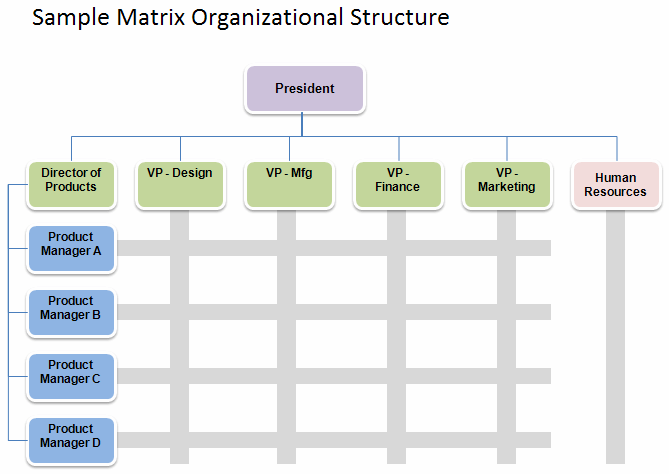
Horizontal Workflows in
organisational charts that formally allows cross functional communication,
workflows and temporary dotted line reporting relationships to happen with view
to (value creating) cross functional projects.
A documented process of
employee innovation that provides a structure to generate, harness and return
(employee) new product ideas into a proposal to project workflow building
esprit de corps amongst participants.
A company culture that is flexible such
as a clan or adhocracy culture. Such a provision will come from flexible two
way communication, active management engagement with employees and systemic
project resourcing for vetted new product ideas along with organisational
refinement and continuous improvement projects. The new cultural norm should be
change. It’s an exciting thought when it is structured, process driven and
recognised by management as a key value attribute in their organisations
success. To set project resourcing in context in a company, every job should be
4 parts function and 1 part project
Trust, managing collaboratively.
If you want your employees to invest in you, you need to invest in them. Good
employee health plans and 401ks are not enough. Involve employees in creating a
sustainable future for your company and you will not only gain their trust, you
will gain their engagement, commitment and expertise as they commit to a common
longer term success. In such a context, you are asking them to live upto their
potential, not to the limits placed upon them by their job description.
Collaborative leadership turns “you” and “I” into “we!”

Investors. managing expectations.
Senior Management need to draw a line in the sand for some investors can
be obnoxiously hawkish about short term results. Some fund managers make
millions on shorting stock every day so if asked to take a chance that doesn’t
satisfy a hawkish approach to profitability, they will either dump stock
covering any losses on other deals in their portfolio or become very aggressive
in their demands. Tim Cook of Apple addressed this issue when some investors
became very aggressive on Apple’s position regarding investing in climate
change and green technologies. His answer was clear: “If you want me to do
things only for ROI reasons, you should get out of this stock.”
Apple stock held because despite aggressive demands, management was competent
and confident enough to stand on their own two feet and speak their minds.
Investor relations should be focused on finding the right kind of investor to
invest in the company’s vision for the short, medium and longer term future.
It’s a meeting of minds not on revenue numbers, but on how a company will
operate and what vision will take a company to many times its current size.
Revenue can be relatively mapped to a longer term plan that covers all areas of
importance.
So that is the high level “Twitter” challenge. It’s a
daunting one for a company of any size to do. However, if you have and/or value
the right people, you are ahead before you start. Here are some pointers on
attracting and managing “the right people”:
Define your basic employee:
What attributes does every employee need to have and how do you check for them
pre interview, during the interview process and during employment?
Define your vision, culture and practices:
What company structures will your employees have to
engage in and will they be engaged by collaborative leadership delivering a
strong vision for the future that has good employee participation in its
formation?
Engage your employees: Are
your employees engaged by management proactively practicing consultative
leadership?
Provision and distribute an employee
innovation workflow: Senior level management should announce,
support and policy provision for employee time on projects, sessions
brainstorming new ideas and management of the innovation process pipeline
(proposal to project) with teams bringing projects from inception to market.
Involve your employees in your company’s future and they will involve you in
theirs!

The Twitter challenge if taken will challenge
leadership to set aside a conventional notion that if a company cuts costs, it
will be successful. This is a misnomer distributed by companies who got lucky
to date and should not shroud the truth. The consistent creation of value is
the only way to remain relevant, competitive and solvent into the future. Take
care of your people by making them the drivers of new value creation and they
will take care of your business transforming it into a sustainable enterprise
that is more reactive to market forces. They will see it transformed into an
organisationally flexible company that can react to, rather than consistently
absorb market movements.
Sources/Credits:
Pics;
Credits