Showing posts with label Performance. Show all posts

Wednesday, 15 June 2016

Independent Thinking - Making Waves or Just Making Trouble?

Why independent thinking should not be confused with negativity or just plain trouble-making


We all love the thought of an easy life; one where we don’t worry about bills, money in our pocket or why we have to (v ‘want to’) use the bus to work in the morning! Our career journeys are often primed to identify “independent thinkers” that are destined in our eyes to interfere with our plans for a domestic utopia; with us taking remedial action at the earliest possible opportunity. This phenomenon is more common then one might think and in enough numbers can often lead to a malformed clan culture in companies where protectionism rather than visionary insight dominate the company culture and arguably its destiny…

So, in walks the fear of losing one’s job, being relegated in career progression to the guy with deeper insights and/or just not succeeding like one feels they should ‘cos that guy is just doing better…’ It may sound like a case of jealousy, but it is a herald for more serious organisational issues especially in a company(s) where leadership tends to be weak and reactive in nature.  

Needless to say, this if unchecked ends ups a management issue that can often lead to a rounding on the ‘trouble maker’ to suppress his or her “performance” or even expel them from the organisation in the name of employee satisfaction. A direct chase to the finish line of bad management practice is obviously not the way to go, which is why I would recommend to any manager the following:

Is the person in question a balanced independent thinker, a whiner/neigh-sayer or an out and out trouble maker??? You will find such issues always boil down to the initial person of interest been accused of being one or more of the three. So quick definitions of the three and what to do:

Independent thinker: Articulate, outspoken, creatively intelligent, passionate about topics and can exude an air of confidence that at times may intimidate some. Issues often arise due to misunderstandings and/or folks becoming threatened by their willingness to think and step outside of the corporate box on issues. Defying conventions can lead to ‘witch hunts’ so beware of folks trying to manipulate events to paint a person like this in a bad light. If there is ever a need for creative types, it’s in this information era where innovation happens at an ever faster rate. Direct such engagements towards mutual accepting of each other’s value to the organisation and to each other. After all, absent one, the other will be eventually be out of job when the company fails. Creative and process driven employees make a successful company in partnership with well rounded leadership of both!  

Negativity: Negative, passive aggressively forward in meetings and backbiting anybody they feel like behind closed doors. Such personalities often seek to deflect attention from themselves by targeting an outspoken independent thinker with the traits they actually display. They are arguably the master of ‘dirty politics’ and most difficult to spot as they “seem to be liked” more by the silence of others then by direct compliment. They are socially active in groups spreading gossip and an innuendo in an apparently gleeful manner. They are the proverbial ‘wolf in sheep’s clothing.’ If the person you are informed about is charged with such transgression, I recommend you evaluate the complainant as much as the initial person of interest for signs of deception and follow up for signs of social interactivity that indicate narcissism and a sense of grandiose. Getting them talking about their correctness in an issue at an appropriate time can be revealing in this regard. Be sure that after completing your investigation, the results are impartial and the real narcissist is identified as an issue, which should be symptomatically addressed in a firm manner as they will raise issues due to their inevitable (future) infractions, which affords you remedial reproach. That said, always be impartial but never forget who you are dealing with.

  
Trouble Makers: The need to see how a bad employee behaves can be subtle like the negative employee or down right threatening like the argument makers. I had a crazy guy work for me who at a team meeting in an open space with our team and two senior managers in guest attendance told me to “lay off the drugs” in a loud disrespectful manner when I talking. The counselling session afterwards lead to more verbal abuse on his part where a verbal warning was his prize. If someone makes a claim about someone you know to be like that, then be sure to not jump to conclusions but be ready to follow the prescribed disciplinary process of your company after your initial investigation is complete. The results from the investigation can start the disciplinary process. People like that are not worth the effort and arrogantly detract from a team’s effectiveness and longevity in a real way. They need to be removed and if management don’t support you on it, then find a new job!

So, you can see that independent thinkers are the lifeblood of any company's longevity but if you let bad ones in that carry the traits of negativity and/or trouble maker, then be prepared to act for everybody’s benefit and future. A “good cultural fit” often misses this at selection letting in the bad ones and keeping the good ones out. As a manager, it then becomes your problem to fix it and fix it we must!

About the author: John Mulhall is a Community Manager and newly Minted Software Developer. John is also a committed blogger and from February 2016 onwards, will be publishing blogs every second week on topics around Technology, Leadership and Sustainable Capitalism.


Sources/Credits:

Pics;


Credits:


Tuesday, 3 June 2014

Giver/Taker Cultures... the misery trap hitting your company’s bottom line?

Attitude!!... What inspires some is despised by others...


I always loved the motto in the three musketeers movie “all for one, and one for all!!”… Hooray for good ethics, collaboration and professional skill winning out the day!!... I cannot say “the Cardinal of the Red Guard” character in the movie would agree though!!... Apparently, in his world, collaboration and fellowship are ugly words!
  
So, what is giver/taker culture, why is it important for sustainable business and how can we manage the cultural concepts? The Giver Taker culture is a ranged cultural focus on collaboration and mutual assistance or self-interest and manipulation to achieve goals and objectives in a group setting. In 2008, Bill Gates said, there are two great forces of human nature—self-interest and caring for others.” He was right as it describes the giver taker culture, which has being defined after 9/11 to try and capture the reasons for the US Intelligence failures that led to the single largest loss of life due to a foreign attack on United State’s soil. The team of Harvard psychologists led by Richard Hackman investigated the phenomenon and in their findings, the “giver take culture" was born.

One of the more notable characteristics of the model is its effective simplicity. The model is designed into three main classifications as follows:

Giver (team player/contributor/assist without expectation of reward/collaborative)

Matcher (will assist for equal reward or return assist/never gives more then they receive/fearful to support any action against “taking” behaviour)

Taker (individualistic/always looks to take ungratefully/no feeling of obligation to assist/self centred/autocratic)

The model based on the Harvard research goes into to say that givers are recessive to the value exchange with takers and thus become targeted by takers. It also says that givers do not do well in a “taker culture” whereas takers tend to do well for a period of time in a giver culture at the expense of givers, which can seriously damage and disrupt a company with a giver culture. Matcher's tend to do well in a taker culture given their adversity to team assistance for fear of being targeted by takers. They also can do well in giver cultures given their more relaxed but matching behaviours that provides limited team support based on the environment as they see it.

Professor Adam Grant
A foremost expert on giver taker culture in my view is Adam Grant, a Wharton Professor and Psychologist who said in a McKinsey & Co article about giver teams “In the highest-performing teams, analysts invested extensive time and energy in coaching, teaching, and consulting with their colleagues.” He is very correct, the human touch in leadership, strategy and operations makes for the utilisation of employee potential in a collaborative group setting leading to higher performance, outputs and sustainable results over time. Conversely, a taker culture is more inward and self-centred leaving little room for actions that don’t lead to gain for the individual in a taker environment. This suits more hierarchy and market based organisational cultures where taker cultures tend to be less focused on the person and more on the vertical structure or the transaction. The giver culture on the other hand is more relevant to adhocracy and clan cultures where collaboration and people are the cultural focus. The resulting cultural blends lead to very impacting performance levels especially in organisations that have service or quality aspects to their product range and/or internal infrastructures.

Shall we do some research on your company to see if its giver or taker culture works in the wider company culture? Ok, let’s do this! So starting out does your company culture generally focus on:
  • 1.     Transaction processing by any means possible at lowest cost (Market Culture)?
  • 2.     Focus on process and one-way communication from the top down in a command in control type structure (Hierarchy Culture)?
  • 3.     Focus on collaboration and flatter structure of management with scope for project management being done efficiency (Adhocracy Culture)?
  • 4.     Focus strongly on people and relationships to the point where strong bonds of fellowship exist in definable social groups throughout the organisation (Clan Culture)?

No company just does one of the above; it’s a game of averages in any estimation. However, if your overall sense of what your company does fits into one of the above, then you are in business to proceed to see how the human element inputs into the culture blend [giver/taker]. So do you and fellow employees generally:
  • a.    Assist each other without thinking about what you get in return on a regular basis?
  • b.    Feel and display concern for your fellow employees seeing the business in people terms as much as process and results terms?
  • c.     Interact informally with ranks above and below you in a two-way communicative collaborative style?
  • d.    Resolve differences through mutual negotiation and respectful dialogue?

If the above answers to questions “a” through to “d” are positive and match your identification of your companies overall cultural focus in question 3 and/or 4, then there is a good chance you have good cultural alignment to people behaviours and thus can expect sustainability and productivity to be of a good standard. You enjoy a giver culture in a flexible, service and/or creative/innovative oriented industry. The biggest threat to a giver culture is takers. The best defence against takers whom can act like a cancer of negativity and distrust in a giver culture is exclusion. Keep them out at selection stage by developing a selection process that effectively identifies the personality traits through psychometric testing, competence based testing and at least 2 rounds of competence based interviewing. Scenario tests are recommended for selection testing in a giver culture, which should be led in a consultative manner in my view. Bear in mind “matchers” can also do well in the above setting.

On taker cultures, do you and fellow employees generally:
  • a.    Wait for the boss on all “real decisions” whether big or small for fear of making a mistake or upsetting the boss?
  • b.    Rarely see each other as friends and bonds of fellowship, which are formed, are often founded on respect for negative actions to others in your career path? Is this seen as contributing to a ‘powerful’ reputation?
  • c.     Have little concern for the bad luck, plight and distress of others as it’s a “dog eat dog world”?
  • d.    Place greater weighing on what your boss tells you then what you did historically or how it can be done in a better and more efficient manner?

If the above answers to questions “a” through to “d” are positive and match your identification of your companies overall cultural focus in question 1 and/or 2, then there is a good chance your have good cultural alignment to a market culture and/or hierarchy culture which is focused on one way communication, command in control type tasking with your role being more a fulfiller rather then a value adder. This is suitable in industries that change slowly, are consolidated and have a high transactional focus in their day-to-day business, which can clearly be procedurally driven. Once again, selection processes for taker cultures can accept matchers as functional to the success of the organisation. Personality testing should be part of the process to ensure the balance between giver, matcher and taker is enough to add an extra layer of sustainability to the employee mix in your organisation.

In my article on Sustainable Capitalism, I talked about capitalism needing an upgrade to match the faster moving environment of today and the refocus on people in context to the organisation, which should be every company’s no 1 focus. This is relevant when you think how the proliferation of “takers” in teams across the US intelligence community led to information hoarding, inefficiency and mistrust that in aggregate created a material breach in US national security and 911. Companies face a similar sustainability threat from too many takers or any at all depending on the overall company culture.  With awareness of the above, the path ahead and what they want to be as a company can be chartered making sustainable capitalism an attractive proposition for the employee, not to mention the company’s bottom line, longevity and top line growth into the future.   

Wednesday, 21 May 2014

Organisational Flexibility, the rise of the Matrix Management Structure

Today's silo, tomorrows competitive edge!!..


I once asked about the profitability of a product when considering extra payment terms to indirect suppliers in a cross functional meeting, and the Marketing Manager looked at me like I had just killed his first born son! I thought I best not pursue the issue at the time for fear that I be accosted by twenty sword yielding ninjas on my way home making it an even fight!

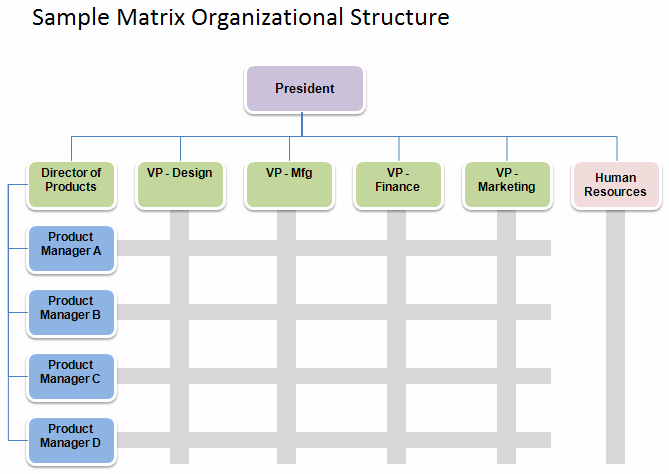
Upon more serious reflection of such defensiveness and numerous subsequent articles on Matrix Management structures, I have reviewed the core vertical management structure/silo concept as established over time by classical management theory and wondered if a need for simple accountability has become an inhibitor to organisational flexibility in today’s increasingly dynamic marketplace?

Source: Vertex 42
http://www.vertex42.com/ExcelTemplates/organizational-chart.html
Considering this, it is not hard to see why others have sought a solution to this problem, which has arisen in recent years due to the rise in technology as an integrated platform operating in business. Matrix management’s rise has also being aided by globalisation and the integration of advanced marketing strategies into big data models identifying market threats and opportunities much earlier then has been in times past. The need for responsive change through project management has become the norm in industries like technology, construction and government agencies that have dealt with fast changing market places for some years prior to other industries.

Matrix Management Structures have arisen initially through these industries but as technology based disruptor's reach more and more markets, the need to be more flexible in today’s marketplace creates a competitive edge and can become a matter of survival if left too late to plan for and adopt organisational structures like the Matrix Management structure.  It makes vertical structures less ‘silo’ and more ‘contributor’ to common goals set by the senior leadership in a dynamic marketplace. Matrix’d management should be managed by a cadre of high calibre functional and programme managers working together to common objectives rather then at odds, which often arises when perceived centres of power are challenged by often well-intended colleagues trying to do their jobs as they perceive them.

It sounds simple right? Well when thinking about the ‘vertical management silo’ we think of the following:

  • ·      Good accountability
  • ·      Good downward communication of goals, objectives and tasks
  • ·      Good visibility of ‘vertical silo’ activity


When we think of ‘matrix management structures’ we think of:

  • ·      Good project charters and functional modus of operation
  • ·      Flexibility to handle organisational and/or market change quickly
  • ·      Close collaboration on a horizontal level with layered visibility from the top down


It is reasonable to think if we lay out our expectations, the organisational benefits would be directly responsible for a world-class organisation? If so, then why are so many struggling with the need for more organisational flexibility and the matrix management structure as a model? The reasons vary from organisation to organisation but I would offer the following points to consider when looking at one’s company in a matrix management model.


ü  People make or break organisations, the matrix management model is people centric, so consider the model in terms of talent management, corporate culture and how accepting functional managers are to the influence and responsibilities a project manager would have in any change initiative. Without awareness and acceptance by all parties, the matrix management structure becomes dysfunctional and ineffective over time.
ü  Ensure the whole organisation is on board, not just one silo or a group of silos. The sponsor of a matrix management structure needs to be at the very top and the follow through needs to be executed at the same level downwards to successfully re-orientate the vertical silos to the matrix management structure in a planned manner so everybody feels secure and accepts their organisational roles into the future.
ü  Ensure the programme/project management structures are appropriately positioned to effect change and improvement in support of, rather then in conflict with functional silos.
ü  Matrix Management structures offer flexibility but make accountability difficult in complex areas of the business. Make sure the accountability is executed collaboratively using technological means to secure progress and milestone metrics on project and functional areas of operation. The synergy of accountability means projects are managed clearly and collaboratively, as are functional areas. Change management from autocratic management can be difficult but it’s necessary if matrix management structures are to work effectively.
ü  Never consider matrix management structures as an end, but a means to a new modus of operation. The requirements need to be carefully considered against internal readiness, market place dynamics and the strategic plans for the future. Engaging matrix management structures against a narrow window of project management need only will prove problematic and subject to a very high fail risk.


The need to be focused on people in such an increasingly dynamic marketplace has never being so apparent since the 1980s when the last “big push” was on moving the landscape in business. This time, its faster, more dramatic and more impacting leaving those whom balance vision and flexibility with organisational dogma standing into the future. The key always has and always will be people. To quote Debra J. Devine “If we are going to live with our deepest differences then we must learn about one another”. In order to do that we must saddle collaborative leadership practice and culture with a customised matrix model transforming the way we live, work and interact with each other building sustainable business into the future.