Showing posts with label organisational. Show all posts

Thursday, 26 June 2014

Communication, do we really mean what we say?

How the science is eclipsed by the art of communication...


We all love to communicate, it’s a part of who we are as human beings and is more deeply inset into our success as a species then we would think. Why? The answer is simple… we take it for granted. After all, who really thinks about one of our greatest evolutionary gifts in detail as we advance through childhood and onto adulthood launching a career or multiple careers? The art of communication is developed as we go and only a few think about the science that describes the process of communication, which we engage in, on a daily basis.

BusinessDictionary.com describes communication as “Two-way process of reaching mutual understanding, in which participants not only exchange (encode-decode) information, news, ideas and feelings but also create and share meaning.” The process can be set out as follows:

Sender encodes transmission>>>Sender transmits message>>>Receiver receives message>>>Receiver decodes transmission.

This is true for all types of messages over all types of mediums such as a face-to-face conversation, a phone conversation, an email, a letter, a text, a social media post, a media article, etc. In the definition of communication, its good to note that there are two main types of communication that are in every message we send. They are verbal communication and non-verbal communication. Verbal communication is described as “The sharing of information between individuals by using speech.” Non-verbal communication is described as “Behavior and elements of speech aside from the words themselves that transmit meaning.”

In non verbal communication, tone, posture, pitch, hand gestures, use of capitals/bolds/italics/colours/pictures (in written communication mediums) is all relevant to how the receiver receives, decodes and understands the entire message, both verbal and non verbal in content/meaning. When we look at it this way, we can see how even a blog article on communication has a two way communicative characteristic by the way the article is written in content and meaning to how the reader decodes the article. Do all readers get the same meaning and content? I hope so…. but the wider the audience the more impacting subtle inferences of non verbal communication are in the receiver’s decoding of content and meaning. So folks, I guess I need to get this one right then!

Figure d) Communication Styles Chart


As you can see, whilst we are all unique, we do fall into some situational categories when it comes to what style to adopt in our approach to people both in the workplace and in life. The need for mutual understanding is critical in all meaningful communication and thus I submit it should be a key metric in measuring effective communication. If absent, then meaning is also forgone in the message and a message without meaning is not an effective message at all. 

In my professional experience to date, I have experienced issues with communication, knowing when to speak up, hold my silence, etc. There is so much more learnt by experience thus I think it is fair to say that emotion is embedded in all communication driving ‘our communicative art’ over time. In a sustainable world, our ability to recognise emotion for its ever present value and vice is an inherent part of our success and/or failure given the subtle yet impacting influences it has on our ability to communicate and perform on a daily basis.


Figure e) Emotional Communication Wheel


I would offer the following pointers on communication to further the cause of effective communication for all.

Small talk matters. Small talk in in the work place is like walking on hot coals for some. Be that as it may, small talk has proven to be key to group successes big and small, so the next time someone asks you about your weekend, take two minutes at the water cooler to talk to them about theirs and what’s going on in the office. Its small but can aggregate positively to the overall level of group cohesion and performance/success potential within the group.

Watch your body language. Non-verbal communication is a bigger deliverer of meaning then the verbal content of any conversation. Body language showing emotions like anger, joy, sadness, happiness, which contradict your message’s content, inhibits the impact of the content and creates confusion for the receiver whom is having trouble decoding meaning from your message. Unify your message; encode your body language to be consistent with your content, which increases the efficacy of your message with the receiver. As a side, if your situation becomes confrontational and your counter party is aggressive, ensure your body language doesn’t naturally become aggressive in response… always respond to aggression with assertion!

Contextualise what you don’t understand. It is only human that you receive a message you don’t understand at some point. When you do, try to not make assumptions about the sender’s motives and meaning. If you don’t understand, ask the sender for clarification as to message context and what was meant by any content that you don’t understand. Albert Einstein once said, “If you cannot explain it simply, then you don’t understand well enough”. He is right, so don’t be afraid to reach out for clarification and contextualise the message ensuring mutual understanding is reached which after-all is the goal of the message.

Communicate collaboratively even in conflict. Too many people think conflict is an exercise leading to a ‘win-lose’ outcome. The fact is that this is an outdated and to be frank inward view of conflict which needs to be updated for companies and employees alike to suffer less as a result of it. A company will have a company culture and set of business practices for conflict but what has being proven in studies and experience going back over decades is that the more collaboratively you communicate in conflict, the better the chances of a successful outcome. Try to lean on a ‘win-win’ approach and communicate collaboratively based on interest based negotiation principles where you seek the goals and objectives of the other side, and explore ways to make it happen whilst not compromising your goals and objectives. The compromise comes on points of contention that arise in the process with mutually agreed outcomes on a ‘win-win basis’.

Never dilute a strong point with a weak follow up. Did you ever make a great point and wish you had just stopped talking at that point? I know I have done so and thus always try to focus on how I am going to communicate in terms of approach and content. What works for me is flagging these points in my head before I enter the conversation/negotiation. This allows me to keep them as content milestone markers in my communication, thus the conversation stays relatively on track and the milestone marker points deliver the essence of what I would have needed to say.

A stitch in time saves nine! Communication is about balance, when to act and when to not. The absence of communicative action is an act of communication in itself. Too often in organisational settings, the impulse to evaluate a possibly contentious situation using inward facing rationale leads to one accommodating the individual whom may be loud, brash and aggressive in their position on a point which you know is wrong but accommodate it anyway. This presents an opportunity cost dilemma that may come back to haunt the organisation in times to come. If you feel you need to speak up, then speak up based on the facts, communicate clearly and keep emotive responsiveness under control especially if the brash colleague decides to challenge your points which is often done as a defensive measure. Try to ensure the opportunity cost of assertion in a timely manner does not exceed the opportunity cost of accommodation for the company over time.


We all wish we had more time to take things back and redo them if we could, but the arrow of time does not afford us such luxuries, thus leaving us with the tools and measure of our experience by which to navigate one of the most critical and long serving aspects of human existence which is communication. A sustainable world relies on it… a bright future depends on it…

Source Links/Credits:

Definitions;
a) Communication
b) Verbal Communication

c) Non verbal communication

d) Communication Styles Chart

e) Emotional Communication Wheel


#Communication, #Sustainable Capitalism, #Sustainable, #Organisational, #HR, #People, #Company Culture, #Development

Tuesday, 3 June 2014

Giver/Taker Cultures... the misery trap hitting your company’s bottom line?

Attitude!!... What inspires some is despised by others...


I always loved the motto in the three musketeers movie “all for one, and one for all!!”… Hooray for good ethics, collaboration and professional skill winning out the day!!... I cannot say “the Cardinal of the Red Guard” character in the movie would agree though!!... Apparently, in his world, collaboration and fellowship are ugly words!
  
So, what is giver/taker culture, why is it important for sustainable business and how can we manage the cultural concepts? The Giver Taker culture is a ranged cultural focus on collaboration and mutual assistance or self-interest and manipulation to achieve goals and objectives in a group setting. In 2008, Bill Gates said, “there are two great forces of human nature—self-interest and caring for others.” He was right as it describes the giver taker culture, which has being defined after 9/11 to try and capture the reasons for the US Intelligence failures that led to the single largest loss of life due to a foreign attack on United State’s soil. The team of Harvard psychologists led by Richard Hackman investigated the phenomenon and in their findings, the “giver take culture" was born.

One of the more notable characteristics of the model is its effective simplicity. The model is designed into three main classifications as follows:

Giver (team player/contributor/assist without expectation of reward/collaborative)

Matcher (will assist for equal reward or return assist/never gives more then they receive/fearful to support any action against “taking” behaviour)

Taker (individualistic/always looks to take ungratefully/no feeling of obligation to assist/self centred/autocratic)

The model based on the Harvard research goes into to say that givers are recessive to the value exchange with takers and thus become targeted by takers. It also says that givers do not do well in a “taker culture” whereas takers tend to do well for a period of time in a giver culture at the expense of givers, which can seriously damage and disrupt a company with a giver culture. Matcher's tend to do well in a taker culture given their adversity to team assistance for fear of being targeted by takers. They also can do well in giver cultures given their more relaxed but matching behaviours that provides limited team support based on the environment as they see it.

Professor Adam Grant
A foremost expert on giver taker culture in my view is Adam Grant, a Wharton Professor and Psychologist who said in a McKinsey & Co article about giver teams “In the highest-performing teams, analysts invested extensive time and energy in coaching, teaching, and consulting with their colleagues.” He is very correct, the human touch in leadership, strategy and operations makes for the utilisation of employee potential in a collaborative group setting leading to higher performance, outputs and sustainable results over time. Conversely, a taker culture is more inward and self-centred leaving little room for actions that don’t lead to gain for the individual in a taker environment. This suits more hierarchy and market based organisational cultures where taker cultures tend to be less focused on the person and more on the vertical structure or the transaction. The giver culture on the other hand is more relevant to adhocracy and clan cultures where collaboration and people are the cultural focus. The resulting cultural blends lead to very impacting performance levels especially in organisations that have service or quality aspects to their product range and/or internal infrastructures.

Shall we do some research on your company to see if its giver or taker culture works in the wider company culture? Ok, let’s do this! So starting out does your company culture generally focus on:
  • 1.     Transaction processing by any means possible at lowest cost (Market Culture)?
  • 2.     Focus on process and one-way communication from the top down in a command in control type structure (Hierarchy Culture)?
  • 3.     Focus on collaboration and flatter structure of management with scope for project management being done efficiency (Adhocracy Culture)?
  • 4.     Focus strongly on people and relationships to the point where strong bonds of fellowship exist in definable social groups throughout the organisation (Clan Culture)?

No company just does one of the above; it’s a game of averages in any estimation. However, if your overall sense of what your company does fits into one of the above, then you are in business to proceed to see how the human element inputs into the culture blend [giver/taker]. So do you and fellow employees generally:
  • a.    Assist each other without thinking about what you get in return on a regular basis?
  • b.    Feel and display concern for your fellow employees seeing the business in people terms as much as process and results terms?
  • c.     Interact informally with ranks above and below you in a two-way communicative collaborative style?
  • d.    Resolve differences through mutual negotiation and respectful dialogue?

If the above answers to questions “a” through to “d” are positive and match your identification of your companies overall cultural focus in question 3 and/or 4, then there is a good chance you have good cultural alignment to people behaviours and thus can expect sustainability and productivity to be of a good standard. You enjoy a giver culture in a flexible, service and/or creative/innovative oriented industry. The biggest threat to a giver culture is takers. The best defence against takers whom can act like a cancer of negativity and distrust in a giver culture is exclusion. Keep them out at selection stage by developing a selection process that effectively identifies the personality traits through psychometric testing, competence based testing and at least 2 rounds of competence based interviewing. Scenario tests are recommended for selection testing in a giver culture, which should be led in a consultative manner in my view. Bear in mind “matchers” can also do well in the above setting.

On taker cultures, do you and fellow employees generally:
  • a.    Wait for the boss on all “real decisions” whether big or small for fear of making a mistake or upsetting the boss?
  • b.    Rarely see each other as friends and bonds of fellowship, which are formed, are often founded on respect for negative actions to others in your career path? Is this seen as contributing to a ‘powerful’ reputation?
  • c.     Have little concern for the bad luck, plight and distress of others as it’s a “dog eat dog world”?
  • d.    Place greater weighing on what your boss tells you then what you did historically or how it can be done in a better and more efficient manner?

If the above answers to questions “a” through to “d” are positive and match your identification of your companies overall cultural focus in question 1 and/or 2, then there is a good chance your have good cultural alignment to a market culture and/or hierarchy culture which is focused on one way communication, command in control type tasking with your role being more a fulfiller rather then a value adder. This is suitable in industries that change slowly, are consolidated and have a high transactional focus in their day-to-day business, which can clearly be procedurally driven. Once again, selection processes for taker cultures can accept matchers as functional to the success of the organisation. Personality testing should be part of the process to ensure the balance between giver, matcher and taker is enough to add an extra layer of sustainability to the employee mix in your organisation.

In my article on Sustainable Capitalism, I talked about capitalism needing an upgrade to match the faster moving environment of today and the refocus on people in context to the organisation, which should be every company’s no 1 focus. This is relevant when you think how the proliferation of “takers” in teams across the US intelligence community led to information hoarding, inefficiency and mistrust that in aggregate created a material breach in US national security and 911. Companies face a similar sustainability threat from too many takers or any at all depending on the overall company culture.  With awareness of the above, the path ahead and what they want to be as a company can be chartered making sustainable capitalism an attractive proposition for the employee, not to mention the company’s bottom line, longevity and top line growth into the future.   

Wednesday, 21 May 2014

Organisational Flexibility, the rise of the Matrix Management Structure

Today's silo, tomorrows competitive edge!!..


I once asked about the profitability of a product when considering extra payment terms to indirect suppliers in a cross functional meeting, and the Marketing Manager looked at me like I had just killed his first born son! I thought I best not pursue the issue at the time for fear that I be accosted by twenty sword yielding ninjas on my way home making it an even fight!

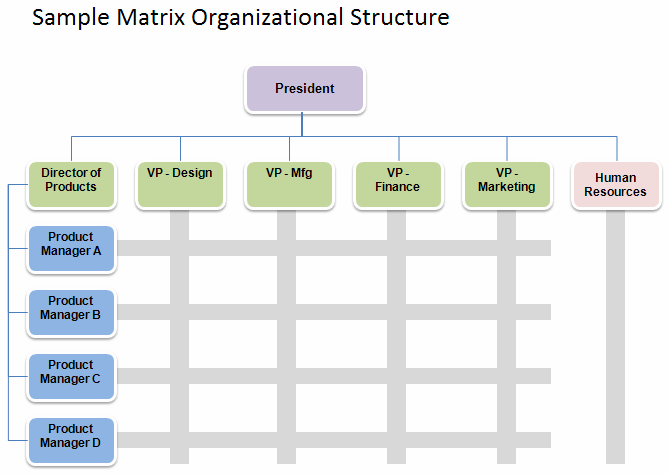
Upon more serious reflection of such defensiveness and numerous subsequent articles on Matrix Management structures, I have reviewed the core vertical management structure/silo concept as established over time by classical management theory and wondered if a need for simple accountability has become an inhibitor to organisational flexibility in today’s increasingly dynamic marketplace?

Source: Vertex 42
http://www.vertex42.com/ExcelTemplates/organizational-chart.html
Considering this, it is not hard to see why others have sought a solution to this problem, which has arisen in recent years due to the rise in technology as an integrated platform operating in business. Matrix management’s rise has also being aided by globalisation and the integration of advanced marketing strategies into big data models identifying market threats and opportunities much earlier then has been in times past. The need for responsive change through project management has become the norm in industries like technology, construction and government agencies that have dealt with fast changing market places for some years prior to other industries.

Matrix Management Structures have arisen initially through these industries but as technology based disruptor's reach more and more markets, the need to be more flexible in today’s marketplace creates a competitive edge and can become a matter of survival if left too late to plan for and adopt organisational structures like the Matrix Management structure.  It makes vertical structures less ‘silo’ and more ‘contributor’ to common goals set by the senior leadership in a dynamic marketplace. Matrix’d management should be managed by a cadre of high calibre functional and programme managers working together to common objectives rather then at odds, which often arises when perceived centres of power are challenged by often well-intended colleagues trying to do their jobs as they perceive them.

It sounds simple right? Well when thinking about the ‘vertical management silo’ we think of the following:

  • ·      Good accountability
  • ·      Good downward communication of goals, objectives and tasks
  • ·      Good visibility of ‘vertical silo’ activity


When we think of ‘matrix management structures’ we think of:

  • ·      Good project charters and functional modus of operation
  • ·      Flexibility to handle organisational and/or market change quickly
  • ·      Close collaboration on a horizontal level with layered visibility from the top down


It is reasonable to think if we lay out our expectations, the organisational benefits would be directly responsible for a world-class organisation? If so, then why are so many struggling with the need for more organisational flexibility and the matrix management structure as a model? The reasons vary from organisation to organisation but I would offer the following points to consider when looking at one’s company in a matrix management model.


ü  People make or break organisations, the matrix management model is people centric, so consider the model in terms of talent management, corporate culture and how accepting functional managers are to the influence and responsibilities a project manager would have in any change initiative. Without awareness and acceptance by all parties, the matrix management structure becomes dysfunctional and ineffective over time.
ü  Ensure the whole organisation is on board, not just one silo or a group of silos. The sponsor of a matrix management structure needs to be at the very top and the follow through needs to be executed at the same level downwards to successfully re-orientate the vertical silos to the matrix management structure in a planned manner so everybody feels secure and accepts their organisational roles into the future.
ü  Ensure the programme/project management structures are appropriately positioned to effect change and improvement in support of, rather then in conflict with functional silos.
ü  Matrix Management structures offer flexibility but make accountability difficult in complex areas of the business. Make sure the accountability is executed collaboratively using technological means to secure progress and milestone metrics on project and functional areas of operation. The synergy of accountability means projects are managed clearly and collaboratively, as are functional areas. Change management from autocratic management can be difficult but it’s necessary if matrix management structures are to work effectively.
ü  Never consider matrix management structures as an end, but a means to a new modus of operation. The requirements need to be carefully considered against internal readiness, market place dynamics and the strategic plans for the future. Engaging matrix management structures against a narrow window of project management need only will prove problematic and subject to a very high fail risk.


The need to be focused on people in such an increasingly dynamic marketplace has never being so apparent since the 1980s when the last “big push” was on moving the landscape in business. This time, its faster, more dramatic and more impacting leaving those whom balance vision and flexibility with organisational dogma standing into the future. The key always has and always will be people. To quote Debra J. Devine “If we are going to live with our deepest differences then we must learn about one another”. In order to do that we must saddle collaborative leadership practice and culture with a customised matrix model transforming the way we live, work and interact with each other building sustainable business into the future.