Wednesday, 21 May 2014

Organisational Flexibility, the rise of the Matrix Management Structure

Today's silo, tomorrows competitive edge!!..



I once asked about the profitability of a product when considering extra payment terms to indirect suppliers in a cross functional meeting, and the Marketing Manager looked at me like I had just killed his first born son! I thought I best not pursue the issue at the time for fear that I be accosted by twenty sword yielding ninjas on my way home making it an even fight!

Upon more serious reflection of such defensiveness and numerous subsequent articles on Matrix Management structures, I have reviewed the core vertical management structure/silo concept as established over time by classical management theory and wondered if a need for simple accountability has become an inhibitor to organisational flexibility in today’s increasingly dynamic marketplace?
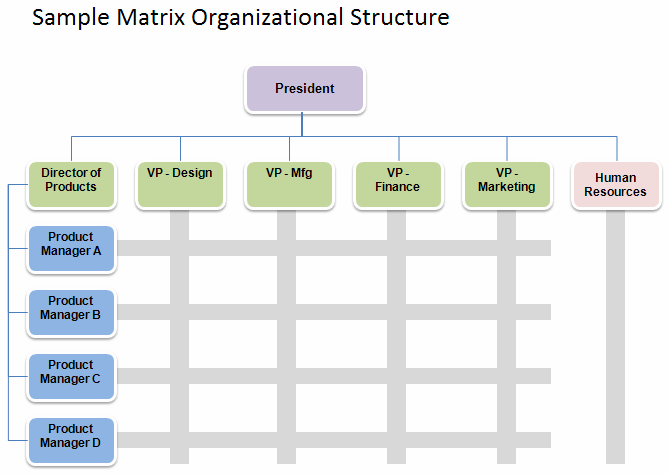
Source: Vertex 42
http://www.vertex42.com/ExcelTemplates/organizational-chart.html
Considering this, it is not hard to see why others have sought a solution to this problem, which has arisen in recent years due to the rise in technology as an integrated platform operating in business. Matrix management’s rise has also being aided by globalisation and the integration of advanced marketing strategies into big data models identifying market threats and opportunities much earlier then has been in times past. The need for responsive change through project management has become the norm in industries like technology, construction and government agencies that have dealt with fast changing market places for some years prior to other industries.

Matrix Management Structures have arisen initially through these industries but as technology based disruptor's reach more and more markets, the need to be more flexible in today’s marketplace creates a competitive edge and can become a matter of survival if left too late to plan for and adopt organisational structures like the Matrix Management structure.  It makes vertical structures less ‘silo’ and more ‘contributor’ to common goals set by the senior leadership in a dynamic marketplace. Matrix’d management should be managed by a cadre of high calibre functional and programme managers working together to common objectives rather then at odds, which often arises when perceived centres of power are challenged by often well-intended colleagues trying to do their jobs as they perceive them.

It sounds simple right? Well when thinking about the ‘vertical management silo’ we think of the following:

  • ·      Good accountability
  • ·      Good downward communication of goals, objectives and tasks
  • ·      Good visibility of ‘vertical silo’ activity


When we think of ‘matrix management structures’ we think of:

  • ·      Good project charters and functional modus of operation
  • ·      Flexibility to handle organisational and/or market change quickly
  • ·      Close collaboration on a horizontal level with layered visibility from the top down


It is reasonable to think if we lay out our expectations, the organisational benefits would be directly responsible for a world-class organisation? If so, then why are so many struggling with the need for more organisational flexibility and the matrix management structure as a model? The reasons vary from organisation to organisation but I would offer the following points to consider when looking at one’s company in a matrix management model.


ü  People make or break organisations, the matrix management model is people centric, so consider the model in terms of talent management, corporate culture and how accepting functional managers are to the influence and responsibilities a project manager would have in any change initiative. Without awareness and acceptance by all parties, the matrix management structure becomes dysfunctional and ineffective over time.
ü  Ensure the whole organisation is on board, not just one silo or a group of silos. The sponsor of a matrix management structure needs to be at the very top and the follow through needs to be executed at the same level downwards to successfully re-orientate the vertical silos to the matrix management structure in a planned manner so everybody feels secure and accepts their organisational roles into the future.
ü  Ensure the programme/project management structures are appropriately positioned to effect change and improvement in support of, rather then in conflict with functional silos.
ü  Matrix Management structures offer flexibility but make accountability difficult in complex areas of the business. Make sure the accountability is executed collaboratively using technological means to secure progress and milestone metrics on project and functional areas of operation. The synergy of accountability means projects are managed clearly and collaboratively, as are functional areas. Change management from autocratic management can be difficult but it’s necessary if matrix management structures are to work effectively.
ü  Never consider matrix management structures as an end, but a means to a new modus of operation. The requirements need to be carefully considered against internal readiness, market place dynamics and the strategic plans for the future. Engaging matrix management structures against a narrow window of project management need only will prove problematic and subject to a very high fail risk.


The need to be focused on people in such an increasingly dynamic marketplace has never being so apparent since the 1980s when the last “big push” was on moving the landscape in business. This time, its faster, more dramatic and more impacting leaving those whom balance vision and flexibility with organisational dogma standing into the future. The key always has and always will be people. To quote Debra J. Devine “If we are going to live with our deepest differences then we must learn about one another”. In order to do that we must saddle collaborative leadership practice and culture with a customised matrix model transforming the way we live, work and interact with each other building sustainable business into the future.

Thursday, 15 May 2014

Asset or Liability? The power of employee potential!

At the helm or out to sea??... How companies value and utilise their employees..


We have all heard the horror stories, the angry elves complaining about the boss and the company, which are the lead weight on their very souls! We cannot say all complaining is whining but when one complains incessantly, we often think of the quote from William Arthur Ward when he said, "The pessimist complains about the wind; the optimist expects it to change; the realist adjusts the sails." So we tend to discount the content of the complaint by the employee and move on with a lower opinion of the employee in reality and maybe an undiscovered source of discontent.

It’s all well and dandy if there is no substance to the complaint or a real will to get the best out of one’s team members. However, as leaders, we are obliged to achieve performance levels with our team(s), which is no easy feat if the winds of discontent and subsequent disengagement sweep silently through our team(s). Not only should we address such issues in private with our team members, we should be mindful for such discontent in our teams through close relationship ties with our people whom often offer up information on such issues that we might not otherwise have known about.

When thinking about our team issues, we should widen our thought process and honestly self reflect; thinking about our leadership impact, corporate leadership styles and guidelines (formal/informal), the department workloads and process requirements, company culture and most importantly, how all this merges with how employees are perceived by the company… are they treated as an asset or a liability?

Business case studies.co.uk have a posted article that suggests employees consider their leaders/manager to have a style that is not engaging. A survey analysis concluded that 21% of managers are perceived as autocratic by their employees, 16% are bureaucratic, 7% are innovative, 9% are trusting, and 7% are empowering. These numbers in my opinion contextualise the low level of leadership efficacy out there in the marketplace in terms of employee engagement, which brings us back to the kernel question, does our company value employees as an asset or a liability?

To answer this question, we must think of what role the employee is in the organisation. Is it a value creator role or a fulfilment role? This is a start in assessing what kind of organisation we are leading in and if it’s the right one for us. Referring to my prior article on company culture, we should not underestimate it in determining our leadership efficacy and how we can adjust to increase it whilst retaining our ‘core inner selves’. Bearing the above in mind, we should then ask the following questions:
  • ü  What kind of company culture does our organisation have, does it support our leadership style and how does it treat employees (value creator or fulfilment role)?
  • ü  Does the company have a prescribed leadership style? If so, are all leaders above and below us practising it or has a sub culture(s) evolved where different leadership styles prevail altering the company culture and operating environment?
  • ü  What kind of prevailing practises are affecting one’s leadership ability and are they predominantly positive or negative? Can they be adjusted to allow one room to operate more effectively in engaging with one’s team(s)?
  • ü  What actual company culture exists, leadership practice predominates and business practice runs our life as a leader? Is it consistent and does it help engage or disengage our team members with the organisation and with us as their leader?
  • ü  What kind of improvements in employee engagement could one make if we altered our approach? Would we compromise core values to be “more effective”?
When thinking about this, one arrives at a picture that defines the organisation and contextualises the value proposition the organisation places on its employees.

In general, one should note that companies, whom are more autocratic by nature and hierarchical in structure, tend to value employees in terms of “doers” and “fulfillers” of roles.  This ‘command and control’ structure leaves little room for two-way communication and other leadership attributes that engages and empowers employees. Successful leaders in such companies inadvertently devalue employees whom are not peers, superiors or revenue generating in sales seeing them as “cost centers” especially at budget time. This “liability” view of employees empowers the few and dis empowers the many especially in large organisation’s where the cumulative effect of employee potential is material when one considers the disengagement of employees from companies whom by design tend to devalue their perceived inputs to that of prescribed service providers.  

Companies with strong hierarchical structures don’t have to be like that. With a little focus and allot of commitment from the top down on cultural and leadership change, autocratic leadership can be augmented with more consultative leadership traits such as mentorship, approachability and controlled two way communication where the rules of upwards communication are seamlessly sewn into a changing company culture and a leadership change management plan. One could with the right plan, support and commitment tap into the unexplored employee potential that is within one’s walls reaping untold rewards for successfully engaging a wider segment of employees whom feed into the operations strategy and direction of the company.

Companies whom value their employees as “assets” by design tend to have thought long and hard about areas like company culture, leadership and business practice as their business is very dependant on engaged and empowered employees thinking like owners in their daily work lives adding value in service quality, new ideas and commitment to the companies vision, work practices and inherent company culture solidifying the company’s sustainable future. The rewards at times can be hard to quantify but are evident in many successful companies in the technology, social media and aviation industries.

Determining a position on what role the employee takes in one’s company is a chance to build something great in a company whom becomes great by the people within its walls each and every day working to a common goal that can be as sustainable as the company wishes it to be. I return to Lao Tzu’s quote where “a journey of a 1000 miles begins with a single step”. If everybody takes that first step together, a new journey of creation begins arriving at great stations of success along a long and sustainable path a company can proudly call its history.